Most CCTV systems installed over the last two decades were built around one assumption: that a human would be watching, or would review the footage later if something went wrong. Neither assumption holds up well in practice. Video Analytics in Modern Security Systems exists because that gap between recording and actually noticing something in time has become too large to bridge with more monitors and more guards.
The Limits of Traditional CCTV Monitoring
A control room with fifty camera feeds and one operator is a common setup, and it doesn't work the way procurement documents imply it does. Sustained attention across that many feeds degrades within minutes a well-documented limit of human vigilance, not a training problem. An operator can miss a perimeter breach on camera twelve while responding to something on camera thirty-one, and there's no way to staff around that except adding more people, which most organizations can't do indefinitely.
Recorded footage fares better for investigation than live monitoring does for prevention, but only if someone knows roughly when and where to look. Reviewing eight hours of footage from twenty cameras to find one incident is slow, and slower still across a multi-site estate where footage sits on different servers with different retention windows and, often, different vendors' software. Traditional CCTV gives you evidence after the fact. It rarely gives you a warning before the fact.
What Video Analytics Actually Does
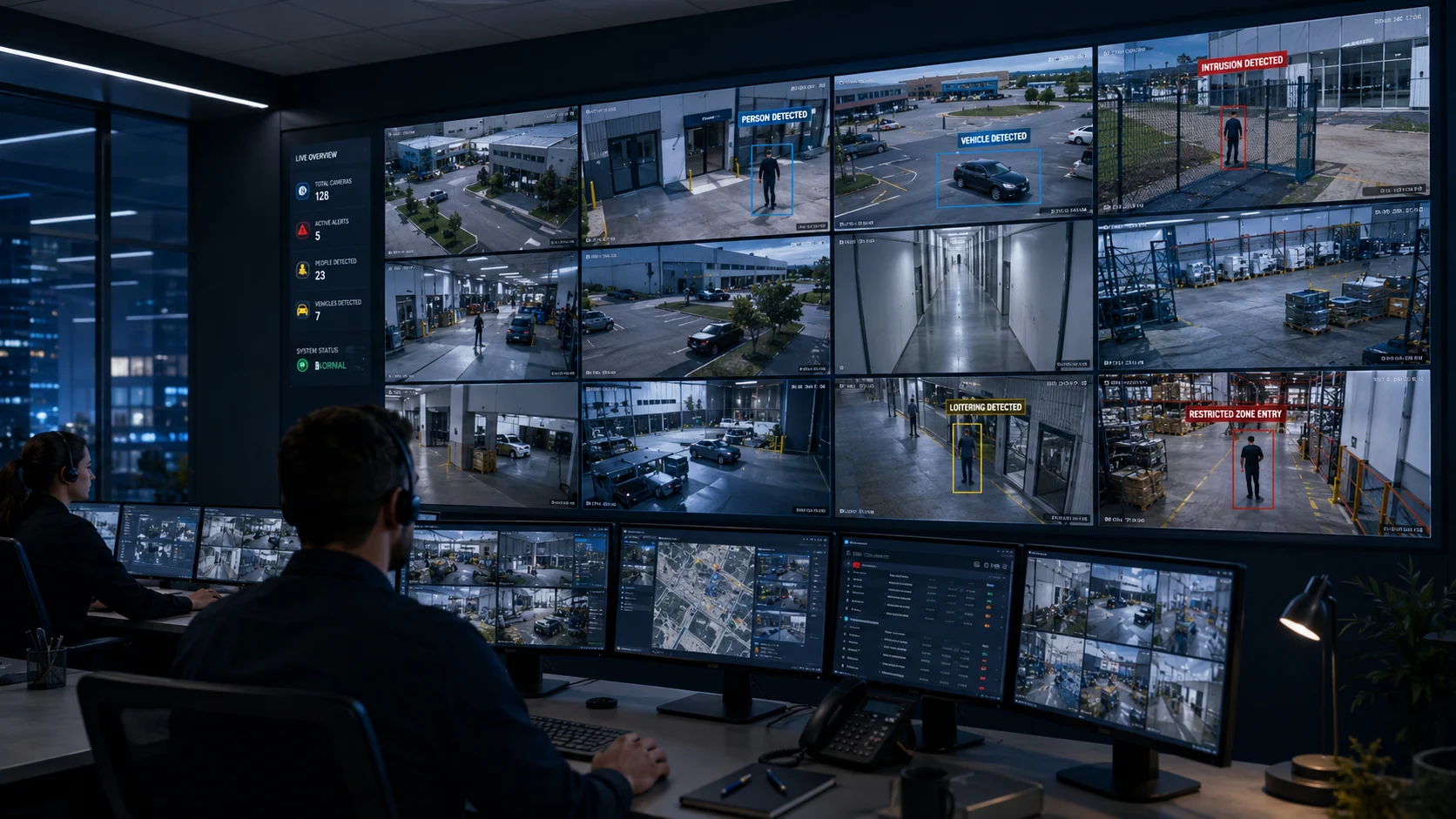
Video analytics applies computer vision models to a camera feed to detect and classify what's happening, in real time, rather than simply recording it. Instead of a human watching for a person crossing a fence line, the system watches continuously and raises an alert only when that specific event occurs. This is the core shift: from a system that stores video for someone to review, to one that interprets video and tells someone when to look.
AI video analytics doesn't replace the camera or the recording; it sits on top of the video feed, processed locally on a server, at the edge on the camera itself, or in the cloud, depending on the deployment. What it changes is which four seconds of a twelve-hour recording actually matter enough for a person to see.
Core Capabilities That Matter in Practice
Most vendors describe video analytics in broad terms. In an actual deployment, what matters breaks down into four distinct capabilities.
Real-Time Event Detection
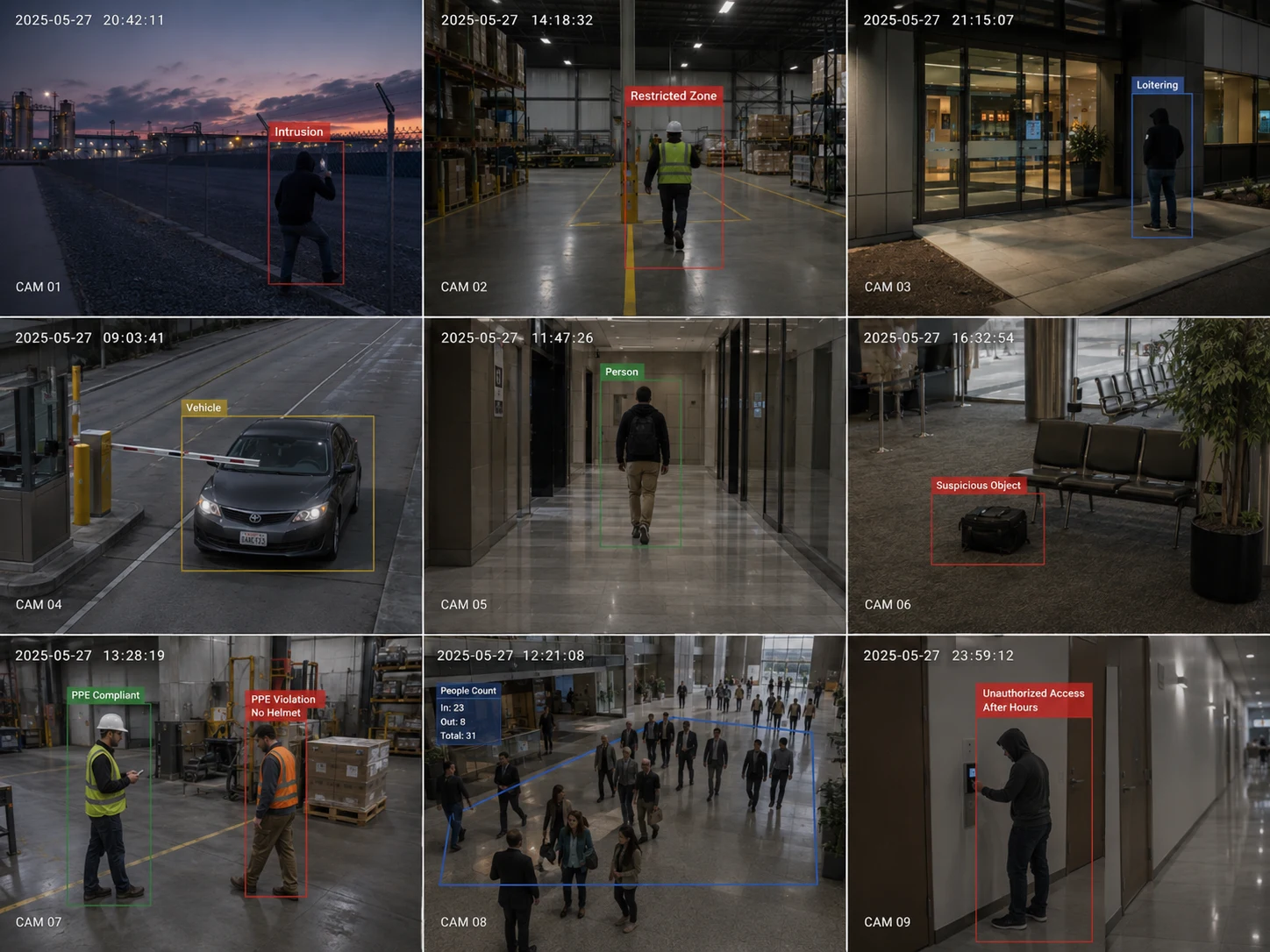
This is the most immediate capability: the system watches a defined zone or condition, a person crossing a perimeter line, a vehicle entering a restricted area, someone loitering near an entrance after hours and raises an alert the moment it happens, rather than someone discovering it later in a recording. Real-time video analytics is what turns a passive camera network into a computer vision security layer that can prompt a response while an incident is still in progress.
The value depends entirely on how well the zones and conditions are configured for the actual site. A perimeter rule tuned for a flat, well-lit boundary will misfire constantly against a fence line with overgrown vegetation or inconsistent lighting, common enough at Indian industrial sites that configuration ends up mattering as much as the underlying model.
Behavioral and Anomaly Analysis
Beyond single-event rules, some systems learn what normal activity looks like in a given camera view and flag deviations from it: a vehicle moving against normal traffic flow, a person moving erratically, activity in an area during hours when it's typically empty. This is harder to get right than rule-based detection, since what counts as anomalous varies by site, by time of day, and by season, and a system trained on one location's patterns doesn't automatically transfer to another.
Behavioral analysis works best as a complement to explicit rules. Rules catch known, definable events reliably; anomaly detection catches the things nobody wrote a rule for, at the cost of a higher false-positive rate that needs active management rather than being ignored.
Object and People Tracking Across Cameras
Tracking a person or vehicle as they move from one camera's field of view into another's, without a human manually cross-referencing timestamps, is one of the more technically demanding capabilities, and one of the more useful for larger sites. It depends on consistent camera placement, overlapping or near-overlapping fields of view where possible, and enough processing power to maintain identity across the handoff rather than treating each camera as an isolated feed.
At a multi-building campus or an industrial site with dozens of cameras, this is what lets an operator follow one individual's path through a facility instead of searching camera by camera, often the difference between resolving an incident in minutes and spending an afternoon on it.
Forensic Search and Investigation Support
After an incident, forensic search lets an investigator query recorded footage by attributes of a red vehicle, a person in a particular colored jacket, a specific time window across multiple cameras instead of manually scrubbing through hours of video. This depends on the same underlying object detection used for real-time alerts, applied retroactively across stored footage rather than live streams.
This capability tends to matter most for security agencies and larger campuses handling frequent investigations, where the time saved compounds across many cases. It's also where the gap between well-organized metadata and raw, unindexed video becomes obvious: search quality depends on what was tagged at ingestion, not only on how good the underlying detection model is.
How Video Analytics Changes Day-to-Day Security Operations
The practical shift is in what an operator's job looks like. Instead of watching a wall of static feeds and hoping to notice something, an operator responds to alerts as they're generated, spending more attention on judgment verifying an alert, deciding on a response than on sustained visual search. This doesn't reduce the need for trained personnel; it changes what they spend their time doing.
Intelligent video surveillance also changes how incidents get escalated. An alert with an attached clip and a location gives a guard or supervisor something concrete to act on immediately, rather than a general report that something might be wrong. For organizations managing security across multiple sites from one control room, this consistency in how alerts are generated and triaged matters as much as detection accuracy itself.
Practical Challenges in Real Deployments
Lighting is the most common practical obstacle. Detection accuracy that looks solid in a demo under controlled lighting can degrade noticeably at dawn, dusk, or under mixed indoor-outdoor lighting typical of Indian warehouses and campuses, and this needs to be tested on-site rather than assumed from a spec sheet. Dust accumulation on outdoor lenses and monsoon-related image degradation, water spots, fogging, reduced visibility during heavy rain add further seasonal variation that a system needs to tolerate rather than simply fail against.
Multi-vendor, multi-generation CCTV estates are the norm rather than the exception at most Indian sites, and analytics software that assumes uniform, modern camera hardware runs into integration friction quickly. Network and power reliability at individual sites also shape what's realistic: if analytics processing depends on a constant link to a central server, an intermittent connection at one site becomes a blind spot at exactly the times reliability matters most. Edge or on-premise processing, with results synced centrally when connectivity allows, tends to hold up better across these conditions than a fully centralized model.
When Video Analytics Delivers the Most Value
Analytics earns its cost fastest in high-traffic or high-consequence areas perimeters at industrial sites, entry points at critical infrastructure, zones where an incident is expensive or dangerous if caught late rather than early. Perimeter video analytics in particular tends to justify itself quickly at large sites where physical patrolling alone can't cover the full boundary continuously.
It matters less at low-traffic, low-consequence locations where a missed event has limited downside, and a simpler recording-only setup may be adequate. The pattern holds across facility types: value scales with how much a delayed response actually costs, not with camera count alone. For large industrial campuses specifically, perimeter length and unpredictable movement patterns make this calculation especially clear.
Implementation Considerations Before Deployment
Start with a site survey, not a product selection. Lighting conditions, existing camera placement and quality, network bandwidth between sites and any central platform, and the specific events that actually matter to that location should all be documented before choosing analytics capabilities; a system configured against a generic checklist tends to underperform one tuned to the actual site.
Pilot on a small number of high-value zones before a full rollout, and expect a tuning period; false-positive rates on day one are rarely representative of a properly configured system weeks later. For organizations already running VMS video analytics across a large camera estate, integration with existing infrastructure and user permissions matters as much as the detection models themselves. Where physical guarding is already in place, video analytics for security works best as an extension of that workforce's judgment rather than a replacement for it, a point worth raising directly with any security manpower or guarding partner involved in daily operations.
Closing Thoughts
Video Analytics in Modern Security Systems comes down to a series of decisions which capabilities matter for a given site, how they're configured for local conditions, and how they fit into an operator's actual workflow. The technology itself is mature; video analytics India deployments still succeed or fail based on the same unglamorous work of matching it to real lighting, real network conditions, and real camera estates.
If you're evaluating this for an existing site, the useful starting point is an honest audit of current blind spots where incidents have gone unnoticed until footage was reviewed after the fact rather than a feature comparison between vendors.
Frequently Asked Questions
1. What is video analytics in a security system?
It's software that watches a camera feed and picks out specific things happening in it a person crossing a line, an object left behind, movement where there shouldn't be any instead of just recording video for someone to look at later.
2. How is video analytics different from traditional CCTV?
CCTV records. Analytics interprets. A traditional system gives you footage to review after something's already gone wrong; analytics is meant to flag the event while it's still happening, so someone can actually do something about it.
3. Does video analytics require cloud connectivity to work?
No it can run locally on a server, on the camera itself at the edge, or in the cloud. In our experience, edge or on-premise processing tends to hold up better where the network isn't always reliable, which describes most sites in India.
4. Does video analytics replace security guards?
It changes what guards and operators actually spend their time on checking an alert and deciding what to do about it, rather than staring at a wall of screens hoping to catch something. The need for trained people doesn't go away; the job just changes.
5. How does lighting affect video analytics accuracy?
More than most people expect. A system that looks solid in a demo can struggle at dawn, dusk, or under the mixed lighting typical of an Indian warehouse. Test it on-site before committing to it don't take a vendor's word for it.
6. Is video analytics only useful for large sites?
Not necessarily, but it earns its cost fastest at high-traffic or high-stakes locations an industrial perimeter, an entry point at critical infrastructure. A small, low-risk site might do just fine with plain recording and skip the extra tuning analytics needs.

Caldwell Simon
Project Manager
Caldwell Simon, Project Manager at Katomaran Technologies, writes on AI video analytics, VMS, IoT integration, and large-scale surveillance deployment and delivery.