Introduction
Cities are growing at an unprecedented pace—bringing together transportation systems, public spaces, residential zones, and commercial hubs into one interconnected ecosystem. With this growth comes complexity. Managing traffic congestion, ensuring public safety, and monitoring vast urban areas is no longer possible with fragmented or standalone CCTV systems.
This is where VMS for Smart Cities becomes essential.
A Video Management System (VMS) is no longer just a surveillance tool—it acts as a centralized intelligence platform that enables authorities to monitor, manage, and optimize city-wide operations in real time. From busy intersections to public spaces and critical infrastructure, a well-designed VMS transforms how cities operate—making them safer, smarter, and more efficient.
What is a Video Management System (VMS) for Smart Cities?
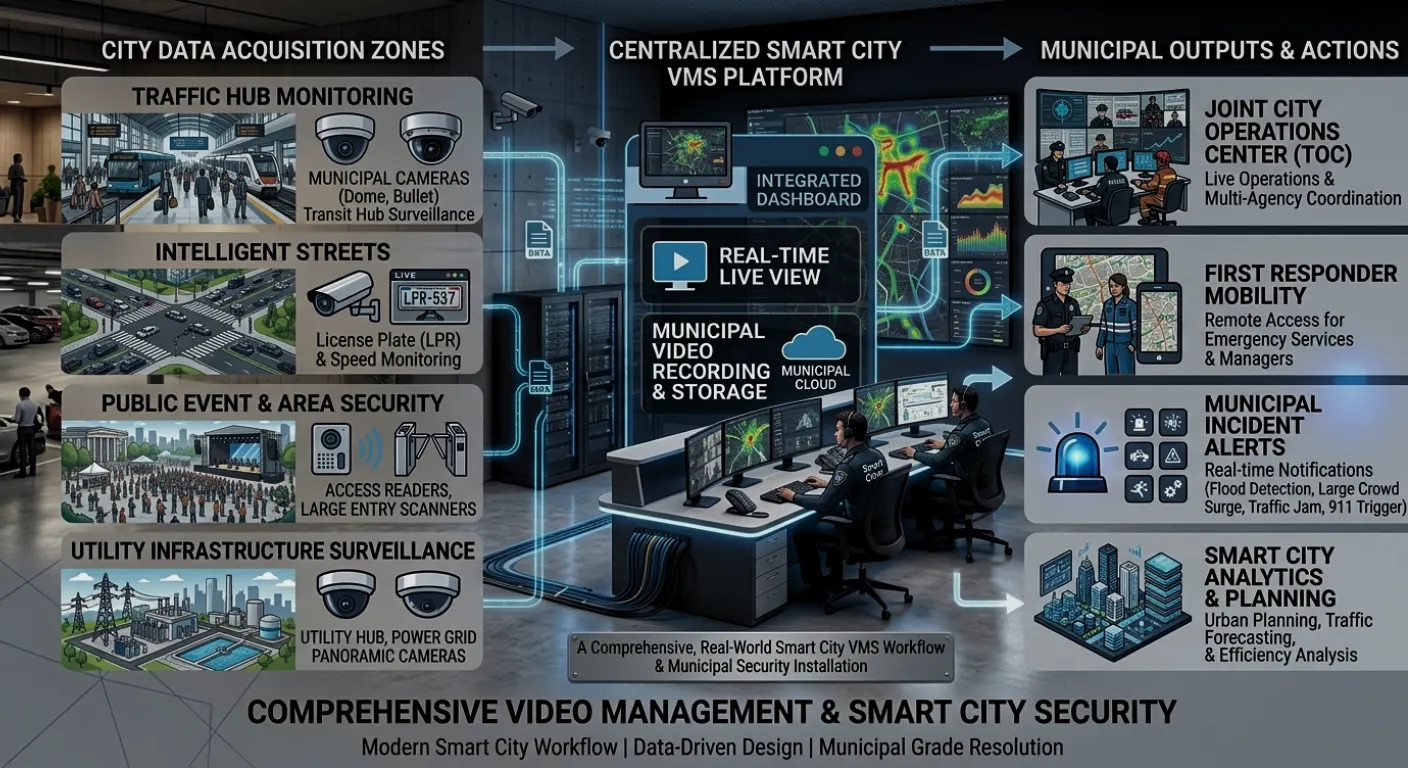
A Video Management System (VMS) for smart cities is a centralized software platform that integrates thousands of cameras across different urban zones into a single, unified system.
Unlike traditional surveillance setups, VMS for Smart Cities provides:
Centralized monitoring across city-wide locations
Real-time alerts powered by AI video analytics
Remote access for authorities and command centers
Integration with traffic systems, IoT devices, and emergency services
This unified approach ensures that city administrators don’t just observe incidents—they respond instantly with actionable insights.
Why Smart Cities Need Centralized VMS
Urban environments generate massive volumes of real-time data. Without a centralized system, monitoring becomes fragmented, slow, and inefficient.
VMS for Smart Cities solves this by bringing all surveillance streams into one intelligent platform, enabling:
Faster decision-making through real-time monitoring
Seamless coordination between departments
Reduced operational complexity
Proactive incident detection instead of reactive response
This shift from reactive to preventive surveillance is what defines a truly smart city.
Centralizing Traffic Management
Traffic congestion is one of the biggest challenges in urban environments. With VMS for Smart Cities, traffic monitoring evolves into an intelligent, data-driven system.
Authorities can:
Monitor live traffic across intersections and highways
Detect violations such as signal jumping or wrong-way driving
Analyze congestion patterns and optimize signal timings
Respond instantly to accidents and road blockages
By combining AI video analytics with real-time monitoring, cities can significantly improve mobility, reduce travel time, and enhance road safety.
Enhancing Public Safety Surveillance
Public safety remains a top priority for any smart city initiative. VMS for Smart Cities enables continuous monitoring of public spaces such as streets, parks, transit hubs, and marketplaces.
Key capabilities include:
Detection of suspicious activities and unusual behavior
Real-time alerts for emergencies and incidents
Crowd monitoring during peak hours and public events
Faster coordination with law enforcement agencies
With intelligent surveillance, authorities can act before incidents escalate—creating a safer environment for citizens.
Urban and Street Surveillance at Scale
Street-level monitoring is essential for maintaining order across a city. A centralized VMS for Smart Cities connects cameras across roads, junctions, and neighborhoods into a unified city surveillance network.
This allows authorities to:
Track vehicle and pedestrian movement across zones
Detect unauthorized access or restricted area violations
Monitor vandalism, theft, or suspicious activities
Maintain continuous visibility across urban infrastructure
With centralized video management, every corner of the city becomes accessible and manageable from a single interface.
Command and Control Centers: The Operational Core
At the heart of VMS for Smart Cities lies the command and control center. This acts as the central hub where all video feeds, alerts, and analytics are managed.
From here, operators can:
View live feeds from thousands of cameras
Receive automated alerts for incidents
Coordinate responses with emergency services
Analyze historical data for planning and optimization
This centralized approach ensures faster response times and better coordination across city departments.
Role of AI Video Analytics in Smart Cities
AI video analytics is the backbone of modern VMS for Smart Cities. It transforms passive video feeds into actionable intelligence.
Key applications include:
Automatic Number Plate Recognition (ANPR)
Facial recognition for enhanced security
Behavior analysis for anomaly detection
Object detection for unattended or suspicious items
Instead of manually monitoring screens, authorities receive instant alerts based on predefined rules—reducing workload and improving efficiency.
Key Features of VMS for Smart Cities
A modern VMS for Smart Cities goes far beyond basic video recording. Essential features include:
Live multi-camera monitoring across city zones
Cloud or hybrid storage for scalability
Smart search and quick video retrieval
AI-powered analytics for real-time insights
Integration with traffic systems, IoT, and emergency services
Role-based access control for different departments
These capabilities help cities operate more efficiently while improving safety and responsiveness.
Operational Benefits Beyond Surveillance
While security is a primary focus, VMS for Smart Cities delivers significant operational advantages:
Improved traffic flow through data-driven insights
Reduced manual monitoring through automation
Faster incident investigation with searchable footage
Enhanced citizen safety and trust
Better urban planning using video analytics
A VMS turns video data into actionable intelligence—helping cities make smarter decisions.
Scalability for Growing Urban Environments
Cities are constantly evolving, and surveillance systems must grow with them. VMS for Smart Cities offers unmatched scalability.
With the right system, cities can:
Add new cameras and locations without disruption
Integrate emerging technologies seamlessly
Manage multiple zones from a centralized dashboard
Maintain consistent policies across departments
This ensures long-term sustainability and adaptability for future expansion.
Challenges and Considerations
Despite its advantages, implementing VMS for Smart Cities requires careful planning.
Key considerations include:
Ensuring data privacy and cybersecurity
Managing large-scale infrastructure costs
Integrating with legacy systems
Training personnel for system operation
Addressing these challenges is essential for building a reliable and secure surveillance ecosystem.
Conclusion: Building Smarter Cities with Katomaran
Managing traffic, public safety, and urban surveillance requires more than isolated systems—it demands a unified, intelligent platform. VMS for Smart Cities brings everything together, offering centralized control, real-time visibility, and actionable insights.
Katomaran delivers advanced VMS solutions designed specifically for smart city environments. With expertise in AI-powered analytics, centralized monitoring, and scalable deployments, Katomaran helps cities:
If you're looking to transform your city into a smarter, safer, and more efficient ecosystem, Katomaran’s VMS solutions provide the foundation to make it happen.
Achieve complete visibility across urban infrastructure
Enhance public safety with intelligent surveillance
Optimize traffic management and incident response
Build scalable, future-ready surveillance systems

Kavinpradeep
Digital Marketer
Kavinpradeep is a Digital Marketer at Katomaran Technologies, creating content on AI video analytics, VMS, IoT, and intelligent surveillance technologies for real-world use.