Introduction
AI video analytics is software that automatically analyses CCTV video to detect people, vehicles and behaviours and send real-time alerts.
A camera system records continuously and reports nothing. That works when someone has a reason to look, and it fails during the hours when no one is looking. The arithmetic is simple. A site with two hundred cameras and three operators gives each person around seventy feeds, which no one can watch. The wall carries a rotating subset, and recordings get pulled after an incident, once the useful window has closed.
AI video analytics changes what the estate produces. The system emits events: a person in a restricted zone at 02:14, a vehicle stopped in a live lane, a worker on a platform without fall protection. Each event carries a location, a timestamp, and a clip, so the footage arrives already sorted into the moments that matter. For anyone already running a large estate, that shift matters more than any single detection capability. The operator moves from scanning to deciding.
What Is AI Video Analytics?
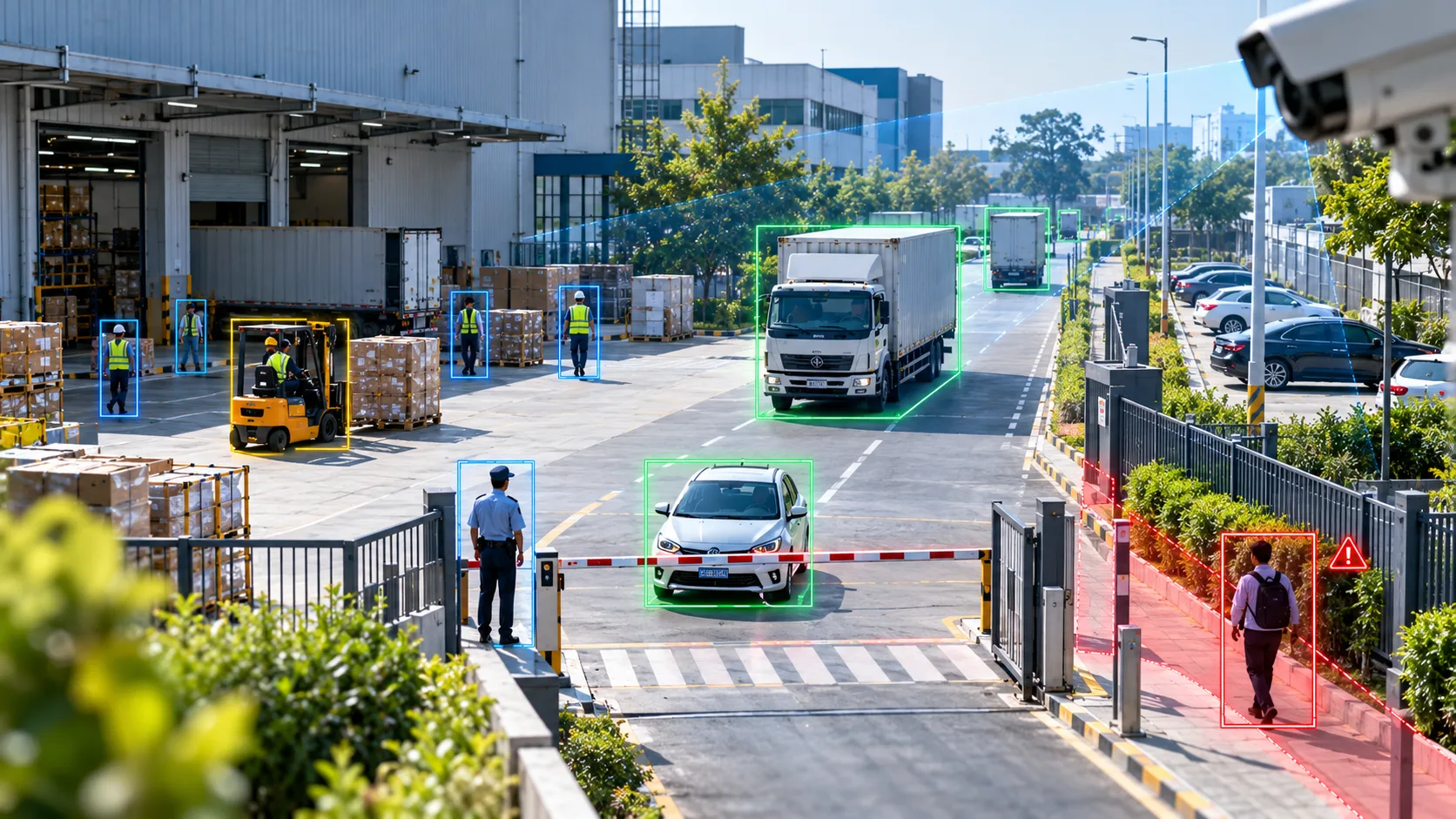
From a systems view, AI video analytics is software that uses computer vision and deep learning models to process video streams continuously, detects objects and behaviours within them, and packages those detections as events other systems or people can act on.
Three properties define it:
- It runs without being asked. Analysis happens on every configured stream at all times, whether or not anyone has that camera open.
- It produces structured output. A detection is a record with a type, a confidence value, a timestamp, a camera identifier, and a region in the frame. That structure makes the output searchable, countable, and routable.
- It is tuned per location. The same model behind the same rule behaves differently at a loading bay and at a boundary fence, because the scene, the light, and what counts as normal all differ.
It does not understand a scene the way a person does. It matches patterns it was trained on and evaluates rules it was given. Katomaran's AI video analytics platform is built around that boundary, with the operator in the decision path.
How Does AI Video Analytics Work?
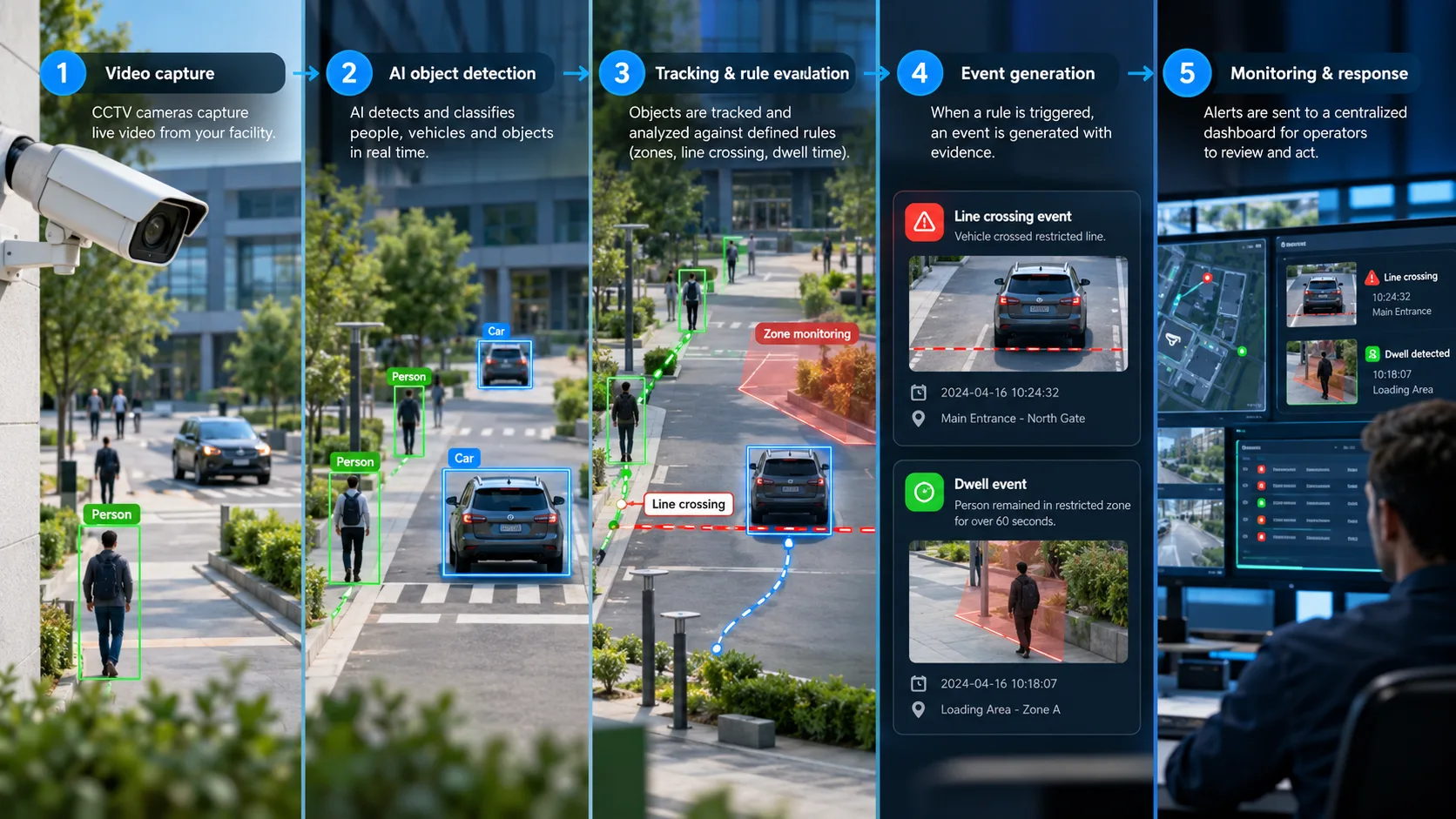
The pipeline has five stages, and each one is a place where reliability is won or lost.
1. Video ingest. Streams arrive over RTSP, usually H.264 or H.265. Frame rate matters more than resolution for most detections, since a feed dropping to a few frames per second loses fast events. Processing happens at the camera, on a local server, or centrally, depending on bandwidth.
2. Object detection. Each frame is analysed for objects of interest, which the model classifies and locates with a bounding box. Model quality shows here, and so does a model trained on the wrong traffic mix.
3. Tracking. Detections across consecutive frames are linked into tracks, giving each object an identity, a path, a speed, and a dwell time. Behaviour rules read from tracks, so tracking failures become detection failures.
4. Rule and behaviour evaluation. Track data is tested against configured logic inside drawn zones: crossing a line, entering a region, remaining stationary past a threshold, moving against a permitted direction.
5. Event generation and delivery. A triggered rule produces an event with its evidence attached, and pushes that event to the VMS, a dashboard, a mobile app, or another system via an API.
Stages two and three take most of the engineering effort. Stages four and five decide whether a deployment succeeds, because a correct detection delivered badly reaches no one who can act on it.
Core Building Blocks
1. Object and Person Detection
The detector locates and classifies what is in frame: people, vehicles by type, bags, and objects relevant to the task such as a helmet or a vest. Accuracy depends heavily on how many pixels the object occupies. A person at the far end of a long yard may be twenty pixels tall, below what most detectors classify reliably, so coverage distance and accuracy trade against each other at every camera position. Local vehicle types matter here. A model trained largely on cars misreads autorickshaws, e-rickshaws, handcarts, and modified goods vehicles, all ordinary traffic on Indian roads and in Indian yards.
2. Tracking Across Frames and Cameras
Within a camera, tracking holds an identity for each object between frames. This is the hardest part in crowded scenes: a forklift passes in front of three people, the detections break, and the tracker has to decide whether the person who reappears is the same one. Across cameras, re-identification tries to match the same object in two views. It works best where fields of view overlap and lighting is consistent, and degrades across non-overlapping cameras with different angles and colour response. Cross-camera identity is a lead for an operator to confirm, and treating it as proof causes problems.
3. Rule and Behaviour Logic
Rules convert tracks into meaning, and they are drawn per camera: line crossing with a direction, zone entry or occupancy, loitering past a dwell time, object left behind, and counting across a boundary. Configuration carries most of the weight. A zone drawn to the frame edge triggers on anything passing distantly behind the fence, and a dwell threshold set for a boundary floods a loading bay. Rules also need schedules, because a person in a yard at 11:00 is a worker and at 02:00 is a question.
4. Alert and Evidence Packaging
An event is useful only with its evidence attached: a still at the trigger, a clip spanning the seconds either side, camera and zone identifiers, a synchronised timestamp, and the rule that fired. Pre-event buffering makes this possible, since the seconds before a trigger are usually the informative ones. Without that package, the operator opens the VMS, finds the camera, scrubs to the time, and spends the minutes early detection just saved.
5. Integration with VMS and Command Interfaces
Analytics events belong inside the tools operators already use: alarms in the video management system alongside everything else, video wall layouts that switch to the cameras around an event, and an API that carries events to access control, a public address system, or a plant SCADA layer. A separate analytics console creates a second place to look, and during an incident operators stop looking at it.
Where Accuracy Depends on Deployment
Model scores are measured on curated footage. Field accuracy is set at the site survey.
- Camera angle and height: A camera mounted low sees objects overlapping constantly and loses tracks. Higher mounting with a shallower downward angle separates them, at the cost of resolution at distance. Cameras positioned for general surveillance are frequently wrong for analytics, so reusing an existing estate needs a camera-by-camera assessment.
- Resolution at the target: What counts is pixels on the object at the distance where detection must happen. A high-resolution camera covering a very wide area can still deliver too few pixels per person.
- Lighting: Mixed lighting is the normal case: sunlit yard and shadowed shed in one frame, headlight glare at a gate, low sun on an east-facing camera twice a day. WDR cameras, separate exposure profiles for day and night, and infrared where needed address most of it.
- Occlusion: Stacked material, parked vehicles, and pillars hide what the camera needs to see. Moving the camera at survey stage solves this; software later does not.
- Frame rate: Low frame rate loses fast events and breaks tracking. A pipeline starved of frames behaves like a less accurate model.
- Network stability: Where links drop, edge analysis keeps running and buffers events for forwarding. Operators also need to see which cameras are unreachable, so a silent camera is never read as a quiet area.
AI Video Analytics Use Cases
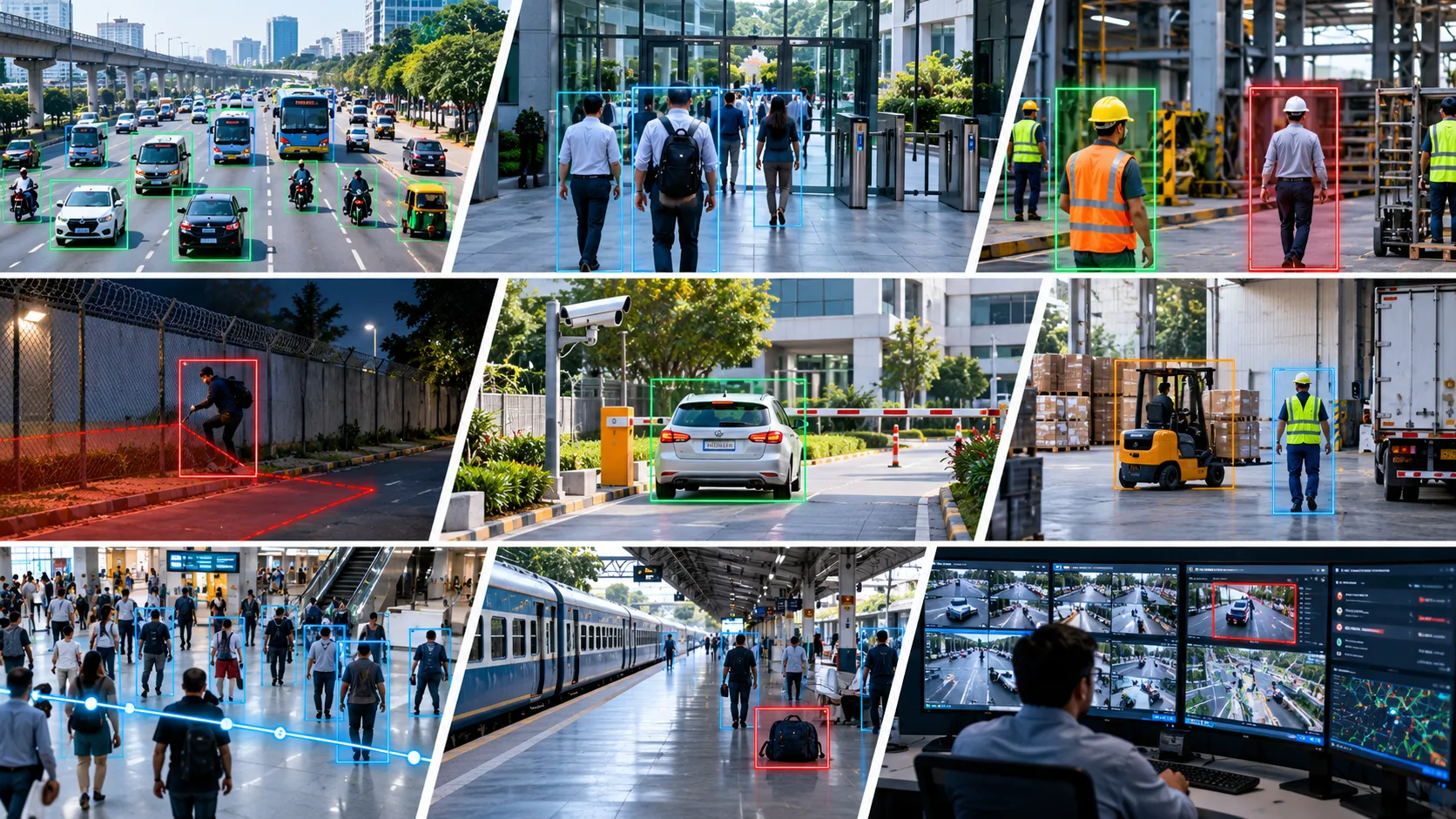
The detections are largely the same across environments. What differs is which rules are drawn, and who reads the output.
AI Video Analytics Use Cases Across Environments
| Environment | Typical Detections | How the Output Is Used |
|---|---|---|
| Security and perimeter monitoring | Line crossing at a boundary, zone entry in a buffer strip, loitering near a fence, movement in areas that should be empty after hours | An alert while the breach is happening. Cameras watching the approach paths, as well as the fence line itself, are what keep alert volume workable. Placement rules are in our piece on perimeter security with video analytics. |
| Safety and compliance on industrial sites | PPE checks for helmets and vests, restricted zone entry around presses and robotic cells, people in forklift paths, crowding at exits | Near-miss evidence, where the pattern across events matters more than any single alert. Configuration detail in our article on PPE and restricted zone analytics. |
| Traffic and road incident detection | Stopped vehicles in live lanes, wrong-way movement, queue growth, debris, plus violation detection and plate recognition | Control-room alerts with an evidence package attached, since an enforcement record has to survive a dispute. On public roads, these run inside an intelligent traffic management system. |
| Access and restricted-zone control | Tailgating at a turnstile, doors held open, entry to areas specific people should not reach | Confirmation alongside a credential or face recognition system: the credential establishes who, and the video establishes how many people went through. |
| Operational monitoring in facilities and campuses | Counting at entrances, queue length at counters, dwell time in zones, vehicle turnaround at docks, bay occupancy | A count or a duration, read daily by operations staff, a different consumer from the security desk watching for alarms. |
In Indian smart cities, AI video analytics feeds the Integrated Command and Control Centre (ICCC). Traffic cameras flag red-light and wrong-way violations and read number plates automatically, while crowd and incident alerts from across the city reach a single control room. Operators see the event, the location and the video together, so police and civic teams can respond in minutes rather than reviewing footage after the fact.
How Operators Actually Use the Output
A useful alert can be judged in seconds. It names what happened, where, and when; carries a clip that shows it; offers the live view one click away; and states a confidence the operator can weigh. What operators do with it is short: confirm from the clip, escalate or dismiss, and record a reason either way. Those dismissal reasons are the most useful data the system produces in its first months, because they show exactly which rules are misfiring and where. Because every detection is stored as searchable metadata, operators can also run forensic search, finding every red car or every person at a gate across hours of footage in seconds.
False positives decide whether the deployment survives. Every lever is a configuration lever: zones drawn to exclude routine activity, dwell thresholds set per location, schedules on every rule, minimum object sizes, and deduplication so one event seen by three cameras arrives as one alert with three views. Alert volume has to fit the staffing of the room receiving it. A system producing more alerts than operators can process trains them to dismiss everything, including the one that mattered.
Analytics events also belong inside the existing workflow. Where several sites report to one control room, that means events from every site arriving in the same queue with the same handling, the pattern our article on multi-site VMS centralisation describes.
Limits and Realistic Expectations
- Current systems handle well-defined geometric and temporal questions reliably: did something cross this line, is something in this zone, has it been stationary past this threshold, how many crossed. Object classification on reasonably sized targets in adequate light is dependable too.
- Intent and context stay outside their reach. A system can report a person standing near a gate for four minutes. Whether that person waits for a colleague or assesses the lock is an operator's judgment, and no confidence value answers it.
- Three expectations are worth setting at the start. Human verification stays in the loop for anything leading to dispatch, enforcement, or a disciplinary consequence. Tuning is continuous work, not a commissioning task, because seasons change the light and site work changes the scene. And maintenance is part of the running cost: lenses need cleaning, mountings drift, and zones need review after any physical change. Accuracy decays quietly when no one owns that work.
Conclusion
The engineering value of AI video analytics is narrow and real: it turns continuous video into timely, verifiable events, with enough evidence attached that an operator can judge each one in seconds.
What decides whether a deployment delivers that is mostly local: where the cameras sit, what the light does through the day, how the site actually operates, link reliability, and how many people staff the room receiving the alerts. If you are weighing analytics for a site or a specific use case, we would be glad to go through those conditions and what the detection layer can realistically deliver.
At Katomaran, our AI video analytics runs on existing cameras where placement allows, deployed at the edge or on-premise, and plugs into our VMS and VSaaS platforms. Our models are trained on Indian conditions, from mixed traffic with autorickshaws to crowded public spaces, and power our ITMS, ATCS and Face Recognition solutions for smart cities, campuses and industrial sites.
Planning AI video analytics for a city, campus or plant? Book a free site assessment with Katomaran.
Frequently Asked Questions
What is the difference between AI video analytics and a CCTV or VMS system?
CCTV cameras capture video and a VMS records and displays it. AI video analytics adds a layer of computer vision that watches the footage automatically, detecting people, vehicles and events and raising alerts so operators don't have to watch every screen.
Can AI video analytics work with existing cameras?
Often, yes, after a camera-by-camera check. Placement, pixels on target, and lighting matter more than brand; cameras mounted for general surveillance are frequently positioned wrongly for analytics.
Should AI video analytics run on the edge, on a server or in the cloud?
It depends on the site. Edge processing reduces bandwidth and latency, on-premise servers suit large camera networks with strict data control, and cloud suits distributed sites with fewer cameras each. Many deployments combine them.
How accurate is AI video analytics?
Accuracy depends on camera placement, image quality, lighting and how rules are configured. Geometric questions (line crossing, zone entry, dwell) are dependable on well-surveyed sites; intent and context remain the operator’s call, which is why alerts are verified before action.
Is AI video analytics used in Indian smart cities?
Yes. Smart city command and control centres across India use AI video analytics for traffic violation detection, crowd monitoring, ANPR and public safety, often alongside intelligent traffic management systems.

Caldwell Simon
Project Head
Caldwell Simon, Project Head at Katomaran Technologies, writes on AI video analytics, VMS, IoT integration, and large-scale surveillance deployment and delivery.