Introduction
City junctions are one of the busiest points in any urban road network. Every day, vehicles, buses, two-wheelers, pedestrians, emergency vehicles, and commercial fleets move through the same road space. When these junctions are not managed properly, even a small delay at one signal can create long queues and affect nearby roads.
This is where ITMS for smart city junctions becomes important.
With real-time traffic monitoring, city authorities can track live traffic movement, detect congestion, identify violations, and respond faster. Instead of depending only on manual observation or traditional CCTV footage, ITMS for smart city junctions helps cities manage traffic in a smarter and more organized way.
An intelligent traffic management system gives traffic teams better visibility, faster alerts, and useful data for decision-making. For modern cities, ITMS for smart city junctions is not just a technology upgrade. It is a practical solution for improving urban mobility, reducing delays, and strengthening road safety.
Why Smart City Junctions Need Better Traffic Management
Traffic congestion is one of the biggest challenges in growing cities. During peak hours, junctions become crowded with vehicles moving from different directions. Buses, cars, bikes, pedestrians, and delivery vehicles all compete for space.
In many cities, traffic signals still work on fixed timings. This means each side of the road gets a fixed green signal duration, even when traffic volume is different. One side may have a long queue, while another side may have very few vehicles. This leads to unnecessary waiting, fuel wastage, and poor traffic flow.
ITMS for smart city junctions helps solve this problem by giving traffic teams live visibility of road conditions. Through real-time traffic monitoring, authorities can understand vehicle density, queue length, lane movement, and congestion patterns instantly.
This allows traffic departments to take faster action and plan better junction control strategies.
How ITMS for Smart City Junctions Works
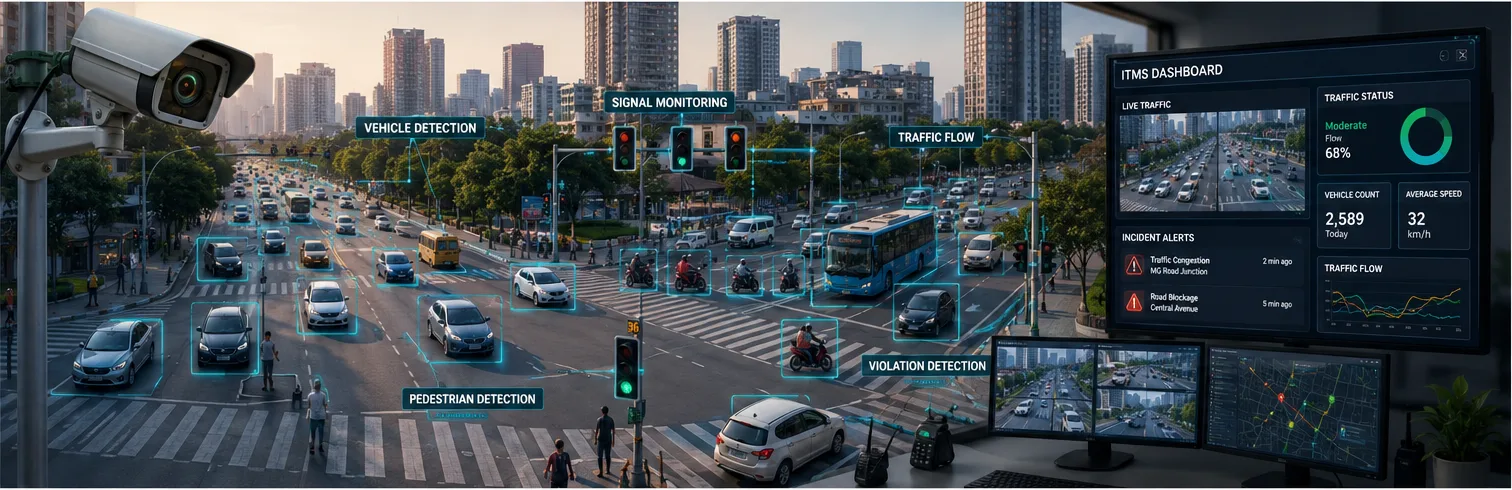
ITMS for smart city junctions works by combining cameras, sensors, AI-based software, and control room dashboards. Cameras installed at junctions continuously capture traffic movement. The system then uses Video Analytics to identify vehicles, monitor lanes, detect violations, and generate alerts.
The system can support vehicle detection, traffic violation detection, automated traffic enforcement, smart traffic signals, adaptive traffic control, and centralized traffic control.
With this setup, traffic teams do not need to manually watch every camera feed all the time. The system automatically highlights important events such as congestion, red-light violations, wrong-way driving, vehicle stoppage, and lane violations.
This makes ITMS for smart city junctions more useful than traditional CCTV because it does not just record video. It converts video into meaningful traffic intelligence.
Reducing Congestion with Real-Time Traffic Monitoring
One of the major benefits of ITMS for smart city junctions is traffic congestion reduction. Traffic volume changes throughout the day. Morning office hours, evening rush, school timings, public events, roadwork, and emergency situations can all affect junction movement.
With real-time traffic monitoring, authorities can quickly identify where vehicles are piling up and which direction needs faster signal clearance. This helps reduce waiting time and improves overall traffic flow.
For example, if one road has heavy traffic and another road has very low traffic, the system can help traffic teams understand the imbalance. In advanced setups, adaptive traffic control can support better signal timing based on live traffic density.
This is one of the key reasons ITMS for smart city junctions is useful for smart cities. It helps departments make decisions based on live data instead of assumptions.
Practical Use Cases of ITMS at Smart City Junctions
ITMS for smart city junctions can be used in many practical traffic situations. At busy commercial junctions, the system can monitor vehicle queues and alert operators when congestion increases. Near schools and hospitals, it can help improve road safety by detecting wrong-way movement, stop-line violations, and risky driving behavior.
At major city signals, ITMS for smart city junctions can support traffic violation detection by capturing red-light jumping, no-helmet riding, triple riding, and restricted lane movement. The system can also help during public events, festivals, or road diversions by giving traffic teams live visibility of changing road conditions.
In emergency situations, real-time traffic monitoring helps authorities identify blocked roads or slow-moving lanes quickly. This supports faster coordination with traffic police, ambulance teams, and field officers.
Improving Road Safety at Junctions
Junctions are high-risk areas because vehicles move from multiple directions. Pedestrians cross roads, two-wheelers move between lanes, and drivers may try to cross signals during rush hours.
ITMS for smart city junctions helps improve road safety by detecting risky behavior in real time. The system can identify violations such as red-light jumping, wrong-way movement, stop-line crossing, no-helmet riding, triple riding, and restricted lane usage.
With traffic violation detection, authorities can act quickly and maintain better road discipline. The system can capture violation images, video clips, timestamps, vehicle details, and location information.
This supports automated traffic enforcement and reduces dependency on manual checking. When violations are detected consistently, drivers become more careful, and junctions become safer for everyone.
Centralized Traffic Control for Smarter Operations
Managing one junction is simple. Managing hundreds of junctions across a city is much more difficult. This is why centralized traffic control plays an important role in smart city traffic management.
ITMS for smart city junctions allows authorities to monitor multiple junctions from a single command center. Operators can view live feeds, check alerts, review violation data, and monitor traffic conditions from one dashboard. When integrated with a VMS, traffic teams can manage live feeds, recordings, alerts, and evidence from a more unified platform.
This centralized approach helps traffic departments respond faster. If congestion is building at one location, the control room can inform field teams immediately. If an accident occurs, emergency response teams can be alerted without delay.
With ITMS for smart city junctions, cities can connect multiple traffic points into one intelligent network. This improves coordination between traffic police, enforcement teams, emergency services, and city administrators.
Role of AI Traffic Analytics in Junction Management
AI traffic analytics is one of the most important parts of ITMS for smart city junctions. It helps the system understand traffic activity automatically.
For example, AI can detect how many vehicles are waiting at a signal, whether a vehicle has crossed the stop line, whether a bike rider is wearing a helmet, or whether a vehicle is moving in the wrong direction.
This level of automation makes ITMS for smart city junctions highly useful for modern traffic operations. It reduces manual workload and improves accuracy.
Instead of watching hours of footage, traffic teams can focus only on important alerts and incidents. This saves time, improves response, and supports better decision-making.
Better Evidence Collection for Enforcement
Traffic enforcement becomes stronger when it is supported by proper evidence. ITMS for smart city junctions can automatically capture images and video clips of violations.
This helps authorities maintain accurate records for enforcement activities. The system can capture vehicle numbers, violation type, time, date, and location. This makes the enforcement process more transparent and reliable.
With automated traffic enforcement, cities can reduce manual errors and improve compliance. The system helps ensure that violations are detected fairly and consistently.
This is one of the key reasons why ITMS for smart city junctions is becoming an important part of modern traffic infrastructure.
Benefits of ITMS for Smart City Junctions
ITMS for smart city junctions provides benefits for both citizens and city authorities.
For citizens, it helps reduce travel delays, improves signal movement, and creates safer roads. For traffic teams, it provides live visibility, automated alerts, better enforcement, and useful reports.
The major benefits include:
Improved traffic flow
Reduced congestion at junctions
Faster incident response
Better road discipline
Improved road safety
Smarter signal control
Stronger violation evidence
Better urban mobility
Centralized city-level monitoring
With real-time traffic monitoring, authorities can act at the right time instead of reacting after the problem becomes serious.
Why Smart Cities Should Adopt ITMS
As cities grow, traffic problems become more complex. More vehicles, more public transport, more delivery movement, and more people on the road create heavy pressure on junctions.
Traditional CCTV and fixed signal systems cannot fully solve these challenges. Cities need intelligent systems that can monitor, analyze, alert, and support quick action.
For cities that require flexible remote access across multiple junctions or distributed locations, VSaaS can also support cloud-based surveillance visibility and easier access to camera feeds when needed.
ITMS for smart city junctions gives cities the capability to connect video surveillance, AI analytics, signal management, enforcement, and command center operations into one smart traffic ecosystem.
By adopting ITMS for smart city junctions, cities can reduce congestion, improve traffic discipline, and create a safer road environment. It also helps city planners understand long-term traffic patterns and make better infrastructure decisions.
Conclusion
ITMS for smart city junctions helps cities reduce congestion, improve road safety, and manage traffic with better visibility. With real-time traffic monitoring, authorities can detect traffic buildup, monitor violations, and respond faster to incidents.
Katomaran Technologies provides AI-powered traffic management solutions with live road monitoring, violation detection, vehicle tracking, video analytics, and centralized traffic control. For smart cities, Katomaran helps build safer, smarter, and more connected traffic management systems.


Kavinpradeep
Digital Marketer
Kavinpradeep is a Digital Marketer at Katomaran Technologies, creating content on AI video analytics, VMS, IoT, and intelligent surveillance technologies for real-world use.