Introduction
Road accidents can happen within seconds, but the response often depends on how quickly the incident is noticed, verified, and reported. In many places, traffic teams still depend on manual monitoring, public calls, or delayed CCTV review to identify accidents. This delay can affect emergency response, increase congestion, and create secondary safety risks on the road.
This is where an Intelligent Traffic Management System becomes valuable. By using AI-powered video analytics, existing CCTV cameras can be transformed into smart monitoring tools that detect accidents, identify unusual road events, and alert control room teams in real time.
Instead of only recording what happened, intelligent traffic management helps authorities understand what is happening now — so they can respond faster.
Why Faster Accident Detection Matters
In road safety, every minute matters. When an accident is detected late, emergency teams may take longer to reach the location, traffic may build up quickly, and nearby vehicles may face additional risk.
Traditional CCTV systems are useful for visual monitoring and evidence collection, but they still require human operators to continuously watch multiple screens. In busy traffic environments, this is difficult and often leads to missed incidents.
AI-powered accident detection reduces this dependency by automatically identifying critical events from live camera feeds. It helps traffic control rooms detect problems faster and take immediate action.
What Is Accident Detection in Intelligent Traffic Management?
Accident detection in an intelligent traffic management system is the use of AI and video analytics to identify road accidents and incident-like events from CCTV footage.
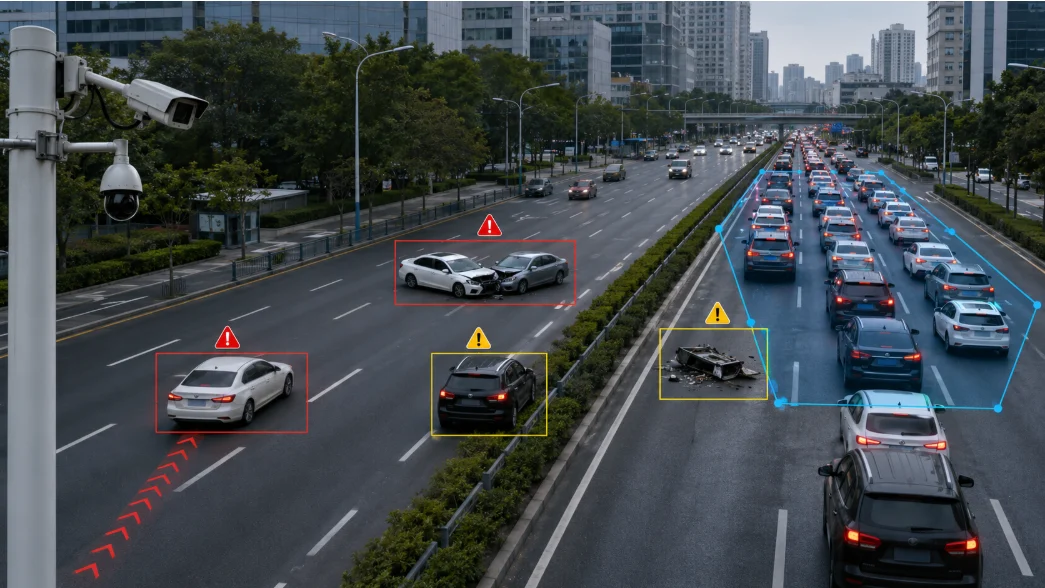
The system can analyze live video feeds from traffic cameras and detect abnormal activities such as:
Vehicle collisions
Sudden vehicle stops
Road blockages
Wrong-way movement
Vehicle breakdowns
Abnormal traffic slowdown
Fire or smoke after an accident
Pedestrian-related incidents
Once an incident is detected, the system generates an alert with the camera location, timestamp, and visual evidence. This allows operators to quickly verify the event and inform the required response teams.
How AI Detects Road Accidents Using CCTV Cameras
AI accident detection works by continuously analyzing road activity through connected cameras. The system studies vehicle movement, speed patterns, object positions, and unusual changes in traffic behavior.
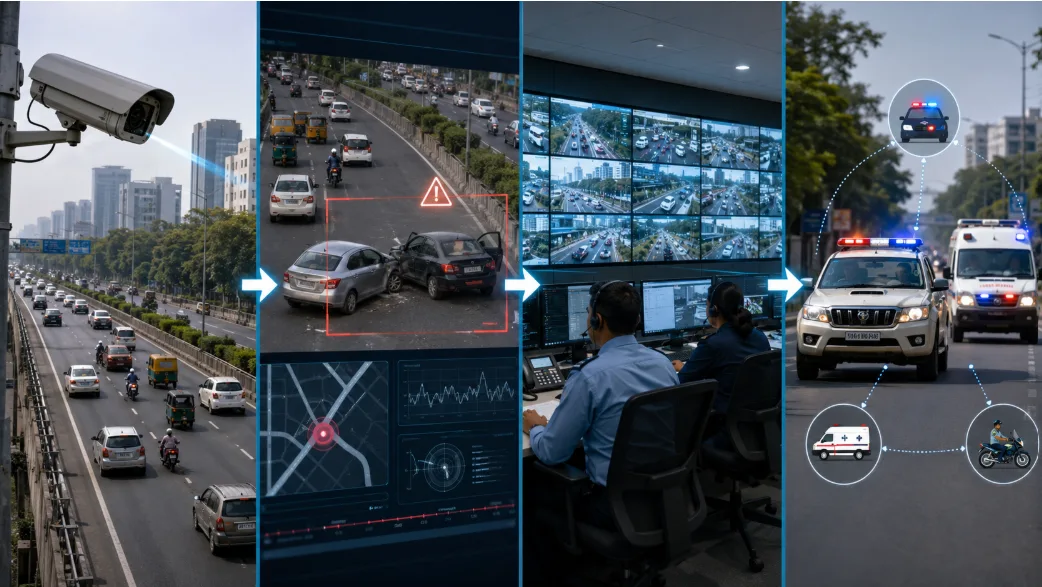
A typical workflow looks like this:
CCTV cameras capture live traffic movement
AI detects vehicles, people, and road objects
The system tracks movement patterns in real time
Abnormal events such as collisions, sudden stops, or lane blockages are identified
An alert is sent to the control room
Operators verify the incident using live video or recorded evidence
Emergency teams, traffic police, or road assistance teams are informed
Diversion or traffic control actions are taken if needed
This process helps reduce the time between accident occurrence and response action.
Key Events an Intelligent Traffic Management System Can Detect
An AI-powered ITMS can support different types of accident and incident detection based on the camera location, road type, and use case.
Vehicle Collision Detection
The system can detect possible vehicle collisions by identifying sudden impact-like movement, vehicle stoppage, or abnormal positioning on the road.
Stopped Vehicle Detection
Vehicles stopped in active lanes can create serious traffic risk. AI can detect stopped vehicles and alert operators before they cause further congestion or accidents.
Wrong-Way Driving Detection
Wrong-way driving is a high-risk road event, especially on highways, flyovers, toll roads, and one-way routes. AI analytics can identify vehicles moving against the expected direction.
Traffic Congestion After Accidents
Accidents often create sudden congestion. Intelligent traffic management can detect unusual traffic buildup and help teams identify the cause faster.
Lane Obstruction Detection
Objects, damaged vehicles, or stalled vehicles blocking lanes can be detected and reported to control room teams.
Fire and Smoke Detection
In some accident scenarios, fire or smoke may appear after vehicle impact. AI video analytics can help identify these early warning signs from camera feeds.
How Real-Time Alerts Improve Emergency Response
The biggest advantage of AI accident detection is real-time alerting. Instead of waiting for someone to notice and report an accident, the system can immediately notify the traffic control room.
A real-time alert usually includes:
Incident type
Camera location
Timestamp
Snapshot or video evidence
Live camera feed
Event status
This helps operators quickly understand what happened and decide the next action. Based on the situation, they can notify traffic police, ambulance teams, fire services, highway patrol, or road maintenance teams.
Faster alerts mean faster coordination.
Role of Command Centers in Accident Response
A command center plays a central role in intelligent traffic management. It allows traffic authorities to monitor multiple roads, junctions, highways, bridges, and accident-prone areas from one place.
When AI detects an accident, the alert appears in the command center dashboard. Operators can view the live feed, confirm the incident, and coordinate with field teams.
This improves:
Incident visibility
Response coordination
Emergency dispatch
Traffic diversion planning
Road clearance monitoring
Evidence review
For large cities and highways, this centralized visibility is essential for faster and more organized accident response.
Why Existing CCTV Alone Is Not Enough
CCTV cameras are already used across many roads, junctions, highways, and public areas. But standard CCTV is mostly passive. It records footage and allows live viewing, but it does not automatically understand what is happening.
This creates a major limitation.
If an operator misses an accident on screen, the system may not raise any warning. The footage may only be reviewed later, after the damage is already done.
An intelligent traffic management system makes CCTV proactive. It adds AI-powered detection, automated alerts, event tracking, and visual evidence to the existing camera infrastructure.
Benefits of AI Accident Detection in Traffic Management
AI-powered accident detection brings several benefits for traffic authorities, road operators, and public safety teams.
Faster Incident Identification
The system detects accidents and road incidents quickly, reducing dependency on manual observation.
Quicker Emergency Response
Real-time alerts help operators notify emergency teams faster and improve response coordination.
Reduced Secondary Accident Risk
Early detection of stopped vehicles, lane blockages, or collisions helps prevent additional accidents near the same location.
Better Traffic Diversion
When an accident causes congestion, traffic teams can plan diversions and manage vehicle movement more effectively.
Improved Control Room Efficiency
AI helps operators focus on verified alerts instead of manually watching multiple video feeds continuously.
Timestamped Visual Evidence
Every detected event can include time, location, and visual proof, making review and reporting easier.
Better Road Safety Planning
Incident data can help authorities identify accident-prone zones and improve future safety planning.
Where AI Accident Detection Can Be Used
AI-powered accident detection can be deployed in many traffic and infrastructure environments.
Smart City Roads
Monitor busy city roads, junctions, public zones, and traffic-heavy corridors.
Highways and Expressways
Detect accidents, wrong-way driving, stopped vehicles, and lane obstruction across long-distance roads.
Flyovers and Bridges
Improve visibility in high-risk elevated road sections where response access may be limited.
Toll Roads
Monitor vehicle movement, lane incidents, congestion, and accident-prone toll areas.
Industrial Roads
Track vehicle movement around factories, logistics parks, and industrial corridors.
Airport Access Roads
Improve safety and traffic flow across airport entry, exit, parking, and approach roads.
Campus and Township Roads
Support safer internal mobility across large campuses, institutions, townships, and private road networks.
Intelligent Traffic Management for Smarter Road Safety
Modern road safety requires more than cameras and manual monitoring. It needs systems that can detect, alert, and support faster decision-making.
An intelligent traffic management system helps traffic teams move from delayed response to real-time road intelligence. It improves visibility, reduces manual dependency, and supports faster action during critical road incidents.
By combining CCTV cameras, AI video analytics, real-time alerts, and centralized command center monitoring, cities and road operators can build a more responsive traffic safety ecosystem.
Conclusion
Accident response starts with faster detection. When traffic teams are notified of an incident immediately, they can act faster, coordinate better, and reduce further road risks.
Intelligent traffic management systems make this possible by using AI to detect accidents, generate real-time alerts, and support control room teams with visual evidence.
As cities, highways, and transport networks become busier, AI-powered accident detection will play an important role in improving road safety and emergency response.

Kavinpradeep
Digital Marketer
Kavinpradeep is a Digital Marketer at Katomaran Technologies, creating content on AI video analytics, VMS, IoT, and intelligent surveillance technologies for real-world use.