The Limitations of Traditional On-Premise Surveillance
Most businesses in India that run physical locations retail stores, warehouses, factories, hospitals, residential complexes eventually hit the same wall. Cameras get installed. Footage gets recorded. Most of it never gets watched. When something actually goes wrong, someone has to dig through hours of local storage, hope the disk didn't fail, hope the right camera was even pointed the right way. Traditional surveillance was built for one job: forensic review, after the fact.
VSaaS Video Surveillance as a Service closes that gap, and it's not a niche idea anymore. The global VSaaS market is on track to roughly double by 2031, from an estimated $6.6 billion in 2025 to $15.64 billion, growing at a ~15.5% CAGR, according to Mordor Intelligence. That growth isn't happening because businesses like buzzwords — it's happening because the old architecture genuinely can't keep up with how surveillance is used today. Here's what VSaaS means, how it works, where it genuinely helps, and where it falls short.
Traditional CCTV and VMS (Video Management System) setups follow a familiar pattern. Cameras connect to a local NVR or DVR. Footage sits on-site. Someone logs in occasionally, usually after an incident, not before one. That made sense when video was purely a forensic tool, something you pulled up only after a theft or accident had already happened. But the way businesses use surveillance today has changed, and the old architecture shows its age in a few consistent places.
Capital expenditure is front-loaded. Servers, storage arrays, licensing, and installation are all paid upfront, regardless of whether the business needs that scale on day one. For a multi-site business, that cost multiplies with every new location, which adds up fast when you're opening branches faster than you're budgeting for infrastructure. The "multi-site" describes a growing share of India's retail economy: organized retail alone is projected to reach $230 billion by 2030, up from $132 billion in 2024, per a Deloitte–RAI report, with major chains like Reliance Retail now operating more than 20,000 stores nationwide. Every one of those stores is a potential surveillance blind spot if it isn't centrally managed.
Monitoring is also site-bound. A store manager or facility head has to be physically near a screen, or dial into a static IP that may or may not be reachable depending on the network at that moment. For a business managing branches across several cities, this stops working pretty quickly. Storage is fragile in ways people underestimate. Local hard disks fail. Footage gets overwritten. And if a break-in disables the NVR itself, the evidence often disappears right along with it, which is, ironically, exactly when you need it most. Maintenance tends to be reactive rather than planned. Firmware updates, storage upgrades, hardware swaps these usually happen only after something has already broken. Then there's power and connectivity.
In many parts of India, fluctuating power and inconsistent broadband are simply operating realities, not edge cases someone forgot to plan for. Traditional systems weren't designed with that variability in mind. A local outage can mean a complete blind spot with no fallback whatsoever. None of this makes traditional VMS obsolete. It still has valid use cases, which we'll come back to later. But it explains why businesses managing multiple sites or businesses that want video to be an operational tool rather than a forensic afterthought have started looking elsewhere.
What VSaaS Actually Means
VSaaS, or Video Surveillance as a Service, moves the video management, storage, and often the analytics layer off local hardware and into the cloud. It's delivered as a subscription, not a capital purchase.
In plain terms: instead of buying and maintaining an NVR, storage array, and VMS software license at every site, a business pays a recurring fee to a provider who hosts and manages that infrastructure centrally. Cameras at each location still capture footage. But recording, storage, retrieval, and monitoring all happen through a cloud-hosted platform, accessible from anywhere with a login.
That's the core idea behind VSaaS explained simply: surveillance moves from a fixed, site-specific asset to a flexible, centrally managed service. If you're comparing this against a conventional setup, our VMS platform overview is a useful place to check what actually changes and what doesn't. Worth being precise here, because the term VSaaS gets used loosely. It isn't just "cameras connected to the internet." It specifically refers to the management and storage layer being delivered as a service; the software, compute, and storage responsibility shifts from the customer to the provider.
How a Typical VSaaS Architecture Works
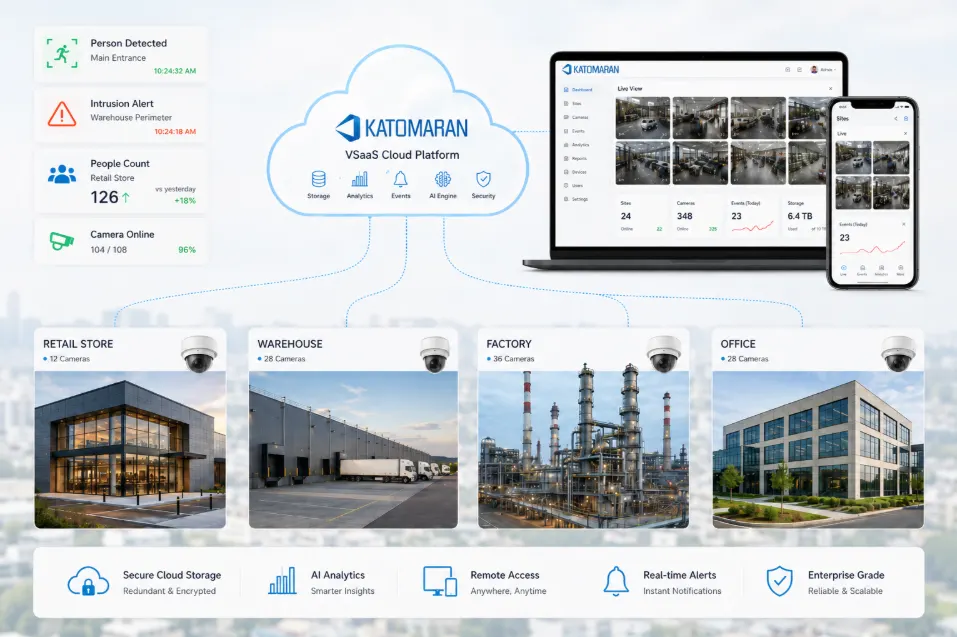
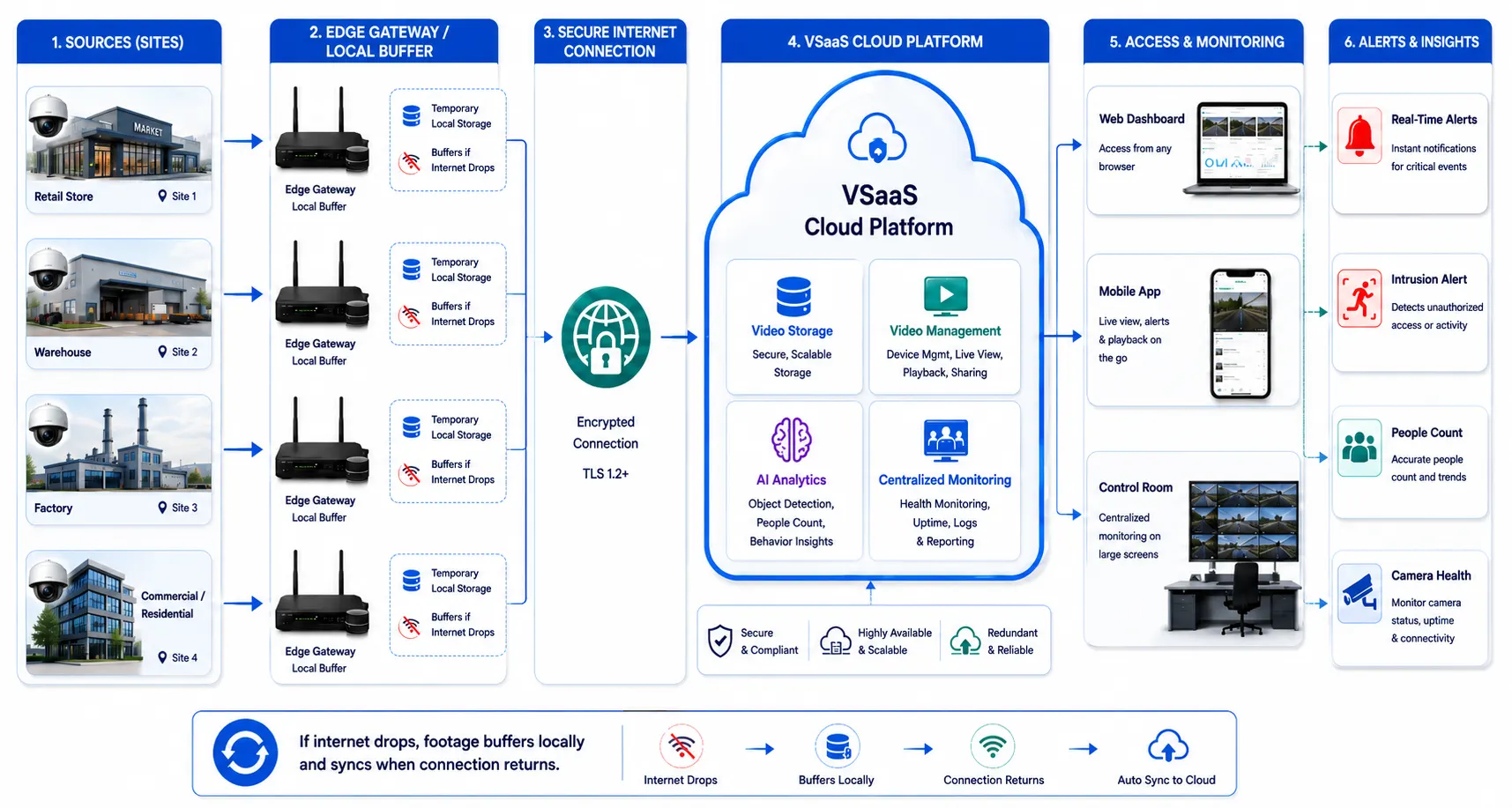
At a mid-technical level, a typical cloud video surveillance setup has a few consistent components, each doing a distinct job.
Edge capture is where it starts. Cameras - IP cameras in most modern deployments capture video at each site. Some architectures add a lightweight on-site device or gateway to handle local buffering and encoding before footage moves onward. This matters a lot in India specifically. It's what lets a few hours or days of footage buffer locally when internet connectivity drops, syncing to the cloud once the connection comes back.
From there, footage moves through the transmission layer, compressed and streamed to the cloud over the site's internet connection. Bandwidth requirements shift depending on resolution, frame rate, and how many streams are active at once. This is one of the genuine planning considerations in any VSaaS rollout, not something to skip past.
The cloud storage and processing layer is really the core of the service. Footage lands on the provider's cloud infrastructure, usually with redundancy built in, so one hardware failure doesn't wipe out your footage. This layer often runs video analytics too — motion detection, people counting, intrusion alerts — without the customer needing separate analytics hardware sitting on-site. Katomaran's AI video analytics platform is built around exactly this: analytics applied at the cloud level, so individual sites don't need their own processing boxes.
Then there's access and monitoring. Authorized users log into a web or mobile interface to view live or recorded footage from any location, on any device, with the right permissions. This is the layer that solves the "manager has to sit in front of a specific screen" problem. Footage becomes accessible the way any cloud application is — from wherever the user happens to be, not from where the hardware happens to sit.
Finally, alerting. Rule-based or AI-driven alerts — an unattended object, someone entering after hours, a queue building past a threshold get pushed to relevant staff in near real time. Not discovered three days later during a manual review.
This layered approach is what separates a genuine cloud-based video management system from just plugging a camera into a router and turning on remote viewing. Management, redundancy, and analytics aren't bolted-on extras here. They're structural — and it's exactly why AI video analytics applied in real operational settings delivers results that a passive camera-and-router setup simply can't.
Key Benefits of Video Surveillance as a Service
The practical VSaaS benefits tend to cluster around a few themes.
Lower upfront cost tops the list for most businesses. Because infrastructure sits with the provider, the customer skips the large capital outlay on servers and storage, particularly relevant for growing multi-site businesses in India, where the alternative is repeating that same outlay at every new branch.
Centralized, remote visibility is the one operations teams notice first. A business with outlets in five cities can watch all of them from a single dashboard instead of juggling five disconnected local systems.
Maintenance burden drops too, since software updates, storage scaling, and system health monitoring sit with the provider rather than an in-house team, useful for businesses without a dedicated surveillance IT function at every location.
There's also resilience against local hardware failure. If an on-site NVR gets damaged, stolen, or simply fails, footage stored in the cloud survives it. That distinction matters for loss-prevention and compliance use cases specifically.
Scaling gets easier. Adding a new site, or more cameras at an existing one, is mostly a configuration and subscription change, with no separate hardware procurement cycle each time. And analytics access comes built in for many platforms: footfall counting, zone intrusion, PPE detection, without needing separate on-premises analytics servers. Our post on how AI video analytics gets applied in real operational settings goes deeper on this.
So Which One Actually Fits Your Business - VSaaS or Traditional VMS?
When people ask about VSaaS vs VMS, the honest answer is that plenty of organizations end up running both, in some hybrid combination, rather than picking one outright. On ownership, VMS means you own and maintain the servers and storage yourself; VSaaS shifts that to the provider. On cost, VMS front-loads capital spend while VSaaS spreads it out as an operating expense. Scaling looks different too. VMS means replicating infrastructure at every new site, while VSaaS scales from a central point. If local hardware fails, VMS footage is vulnerable in a way VSaaS footage typically isn't. IT overhead runs higher with VMS, since maintenance happens per site rather than centrally.
As for which fits better: VMS still tends to suit very large single-site deployments with a dedicated IT team on hand. VSaaS tends to suit distributed, multi-site businesses, or ones without heavy in-house IT. If you're weighing this decision directly, our comparison of VMS versus cloud-based surveillance approaches covers the operational details.
When Does VSaaS Actually Make Sense (and When It Doesn't)
VSaaS tends to make the most sense for businesses spread across multiple locations that need centralized, remote visibility, such as retail chains, franchise operations, warehousing and logistics networks, and residential or commercial property management. It also suits businesses trying to avoid a large upfront infrastructure spend, or ones without dedicated on-site IT staff to keep local VMS hardware running. It needs more careful planning for very large single-site facilities with extremely high camera counts, for locations with genuinely unreliable internet and no edge-buffering fallback, or for organizations with strict data residency requirements a given provider simply can't meet.
For a lot of Indian businesses, the practical answer sits somewhere in between. A hybrid approach local buffering for resilience, cloud for central visibility, analytics, and long-term storage often works better than picking a side outright. Where exactly that balance lands depends on site count, bandwidth reality, and compliance needs.
Closing Thoughts
VSaaS is a fairly logical evolution of how surveillance infrastructure gets consumed, the same shift most enterprise software already went through, from owned infrastructure to managed service, and the market numbers back that up: this is a category growing at roughly 15% a year, not a passing trend.
The right choice between VSaaS, traditional VMS, or some hybrid of the two depends on site count, connectivity reality, and how the business actually intends to use video day to day.
If you're evaluating this for your own sites, start by mapping out camera count, bandwidth availability, and monitoring needs; that groundwork makes the VSaaS-versus-VMS decision much clearer. Explore our VSaaS platform details if you'd like to see how this applies to your setup, or reach out to our team for an honest read on what would actually fit your operation.
Frequently Asked Questions
1. How is VSaaS different from a traditional VMS?
A traditional VMS usually stores and manages video on local infrastructure, while VSaaS shifts much of the management, storage, maintenance, and access to the cloud. VSaaS also makes remote monitoring across multiple locations easier.
2. Does VSaaS require a constant internet connection?
VSaaS depends on internet connectivity for cloud access and video synchronization, but well-designed systems can use local edge buffering so footage continues recording during an outage and uploads once connectivity is restored.
3. Is VSaaS suitable for multi-site businesses?
Yes. VSaaS is particularly useful for retail chains, warehouses, offices, logistics networks, and other distributed businesses because cameras from multiple locations can be monitored through one centralized platform.
4. Can existing CCTV cameras be used with VSaaS?
In many cases, existing IP cameras can be integrated with a VSaaS platform, depending on camera compatibility, supported protocols, network conditions, and the architecture used by the provider.
5. Is cloud video surveillance secure?
A well-designed VSaaS platform can include encrypted transmission, secure cloud storage, user permissions, authentication, audit logs, and system monitoring. Businesses should still verify the provider’s security standards, data residency, and retention policies before deployment.
6. When should a business choose VSaaS instead of an on-premises VMS?
VSaaS generally fits organizations that need centralized multi-site visibility, simpler scaling, lower upfront infrastructure investment, and reduced maintenance. Large single-site deployments with hundreds of cameras or strict local-storage requirements may still benefit from an on-premise or hybrid architecture.


Eswaravel Ekambaram
Co-Founder & COO
Eswaravel Ekambaram is Co-Founder & COO of Katomaran Technologies, driving operations, system architecture, and enterprise deployment of AI video analytics, VMS, and IoT solutions.