
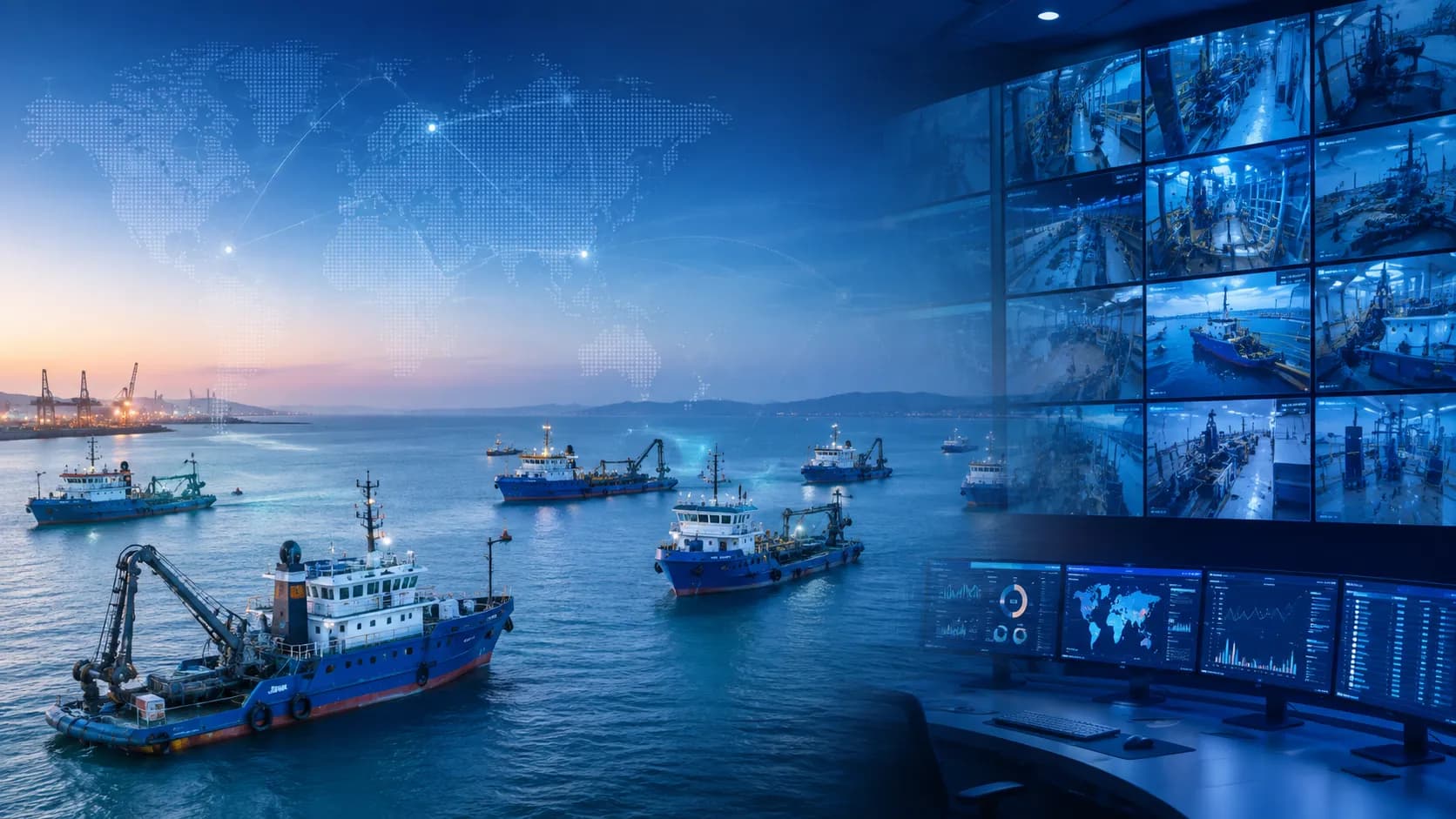
Industry
Maritime / Remote Surveillance
Duration
4 months
Team Size
8 people
Introduction
- Katomaran Technologies implemented an integrated Video Management System (VMS), Video Surveillance as a Service (VSaaS), and AI Video Analytics solution for the Dredging Corporation of India (DCI), enabling centralized surveillance across 8 vessels from a command centre in Vizag.
- As part of the project, we deployed 144 cameras, with 18 cameras installed on each vessel across critical areas including the engine room, control panel, dredger deck and other operational zones. Our solution combines onboard video management, local video analytics and centralized fleet monitoring over VSAT connectivity.
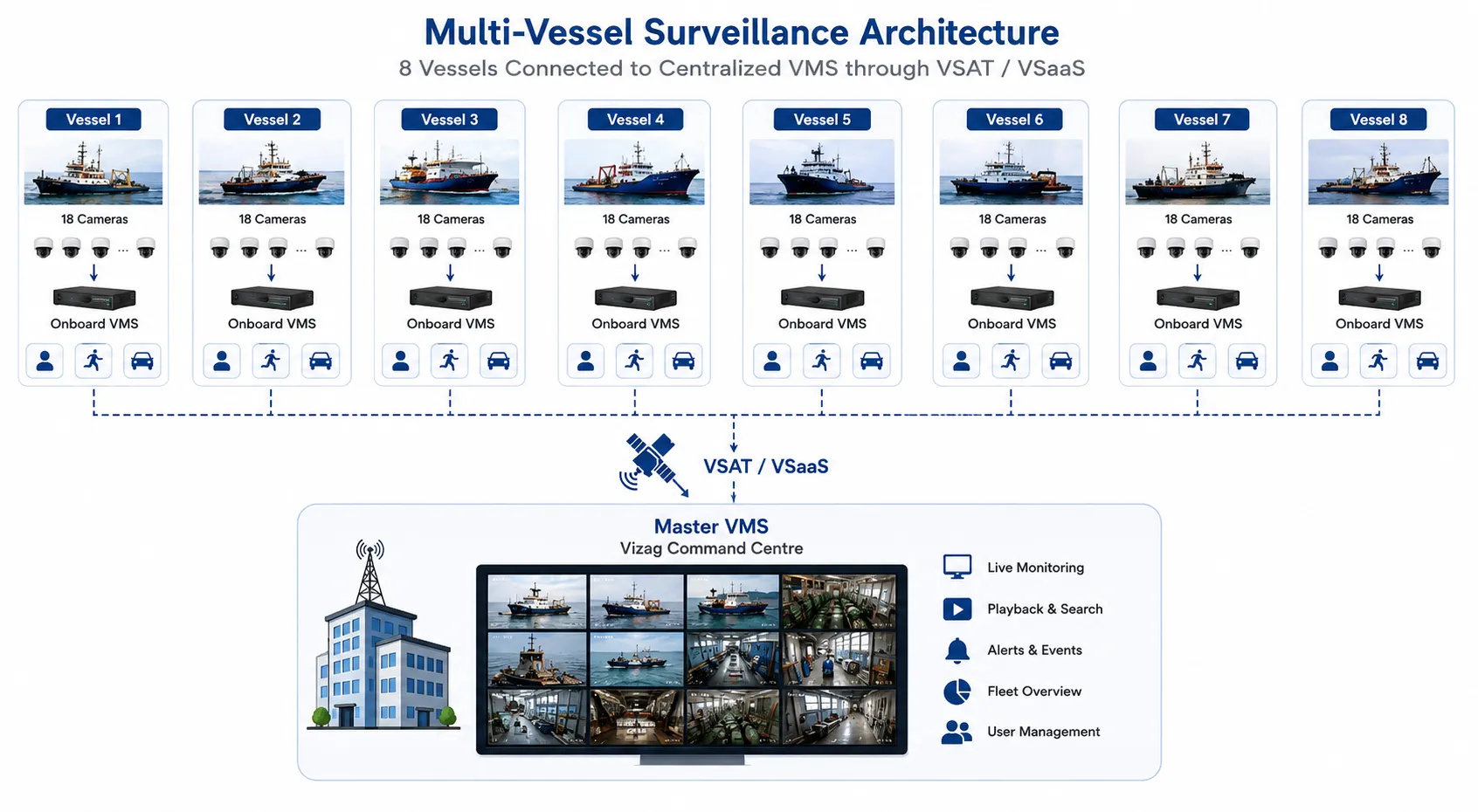
Centralized VMS architecture for multi-vessel surveillance
| Project Detail | Information |
|---|---|
| Client | Dredging Corporation of India (DCI) |
| Vessels | 8 |
| Cameras | 144 |
| Cameras per Vessel | 18 |
| Command Centre | Vizag |
| Camera Type | 4 MP IP Cameras |
| Core Solutions | VMS, VSaaS & Video Analytics |
| Architecture | Master–Worker |
| Connectivity | VSAT |
| Analytics | Person, Intrusion & Vehicle Detection |
Requirement for Multi-Vessel Surveillance
- DCI required a surveillance solution capable of monitoring multiple vessels operating remotely while maintaining local video management and processing onboard each vessel.
- The vessels operate away from the shore-based command centre, making connectivity an important consideration. A conventional centralized surveillance model would require large volumes of video to be transmitted continuously from every vessel to Vizag. With VSAT connectivity and bandwidth constraints, this approach could create unnecessary network load.
- We therefore designed the solution around a distributed surveillance architecture, where video management and analytics could be handled locally while surveillance information remained accessible from the central command centre.
The solution needed to provide:
- Fleet-wide surveillance from one location
- Local video management on every vessel
- Remote access to vessel cameras
- AI-based event detection
- Coverage of critical operational areas
- Efficient use of VSAT connectivity
- Centralized monitoring through a single platform
Our Centralized VMS and VSaaS Solution
- We implemented a master–worker VMS architecture connecting all 8 DCI vessels with the central command centre.
- Each vessel operates as a worker VMS node, managing its 18 cameras, recording and local video analytics. At Vizag, we deployed the master VMS, which connects the vessel-level systems and provides centralized fleet-wide visibility.
- Architecture
- 18 Cameras/Vessel → Worker VMS → Local Video Analytics → VSAT / VSaaS → Master VMS → Vizag Command Centre
- This architecture allows our solution to process video closer to the cameras while providing DCI operators with centralized access to surveillance information across the fleet.
- The distributed architecture also provides a scalable foundation. Additional vessels can be integrated into the centralized monitoring environment without changing the basic surveillance model.
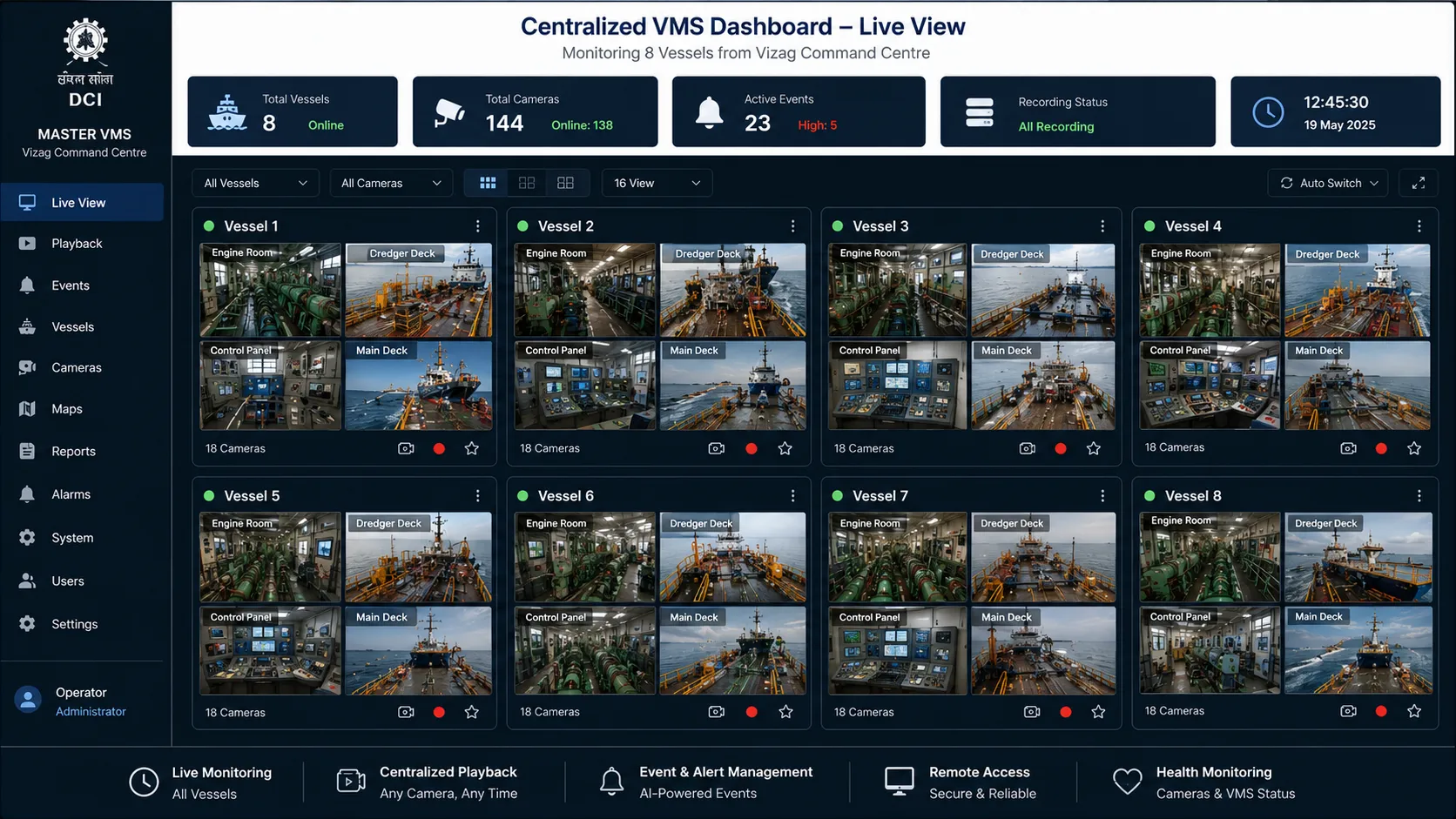
VSaaS platform for remote vessel monitoring
Onboard VMS Management
- The vessel-level VMS manages the connected cameras and provides essential surveillance functions, including:
- 1Live camera feeds
- 2Video recording
- 3Playback and review
- 4Camera management
- 5Surveillance events
- 6Local video processing
The onboard VMS allows each vessel to maintain its own surveillance environment. Video can be managed and processed locally without making the vessel completely dependent on the shore-based command centre.
At the same time, the vessel-level systems remain connected to the centralized monitoring infrastructure, allowing authorized users at Vizag to access relevant surveillance information remotely.
VSaaS for Centralized Remote Fleet Monitoring
- Our cloud-based video surveillance platform connects the distributed vessel surveillance systems with the central monitoring environment.
- Instead of requiring separate monitoring systems for every vessel, DCI operators can access surveillance information through a centralized platform.
- The VSaaS implementation supports:
- 1Remote vessel monitoring
- 2Centralized fleet visibility
- 3Distributed VMS management
- 4Access to vessel-level video and events
- 5Scalable addition of vessels
This provides DCI with a unified monitoring experience even though the vessels are geographically distributed and operating remotely.
The centralized platform also makes it easier for operators to move between vessels, review events and access the required surveillance information from a single monitoring environment.
Real-Time AI Video Analytics
Our AI Video Analytics solution processes video locally on the vessels to identify relevant activities and generate surveillance events.
Person Detection
Person detection identifies people within configured camera areas and generates events for operator review. This can help operators focus on activity in monitored areas without continuously reviewing every camera feed manually.
Intrusion Detection
Intrusion detection can be configured for restricted or sensitive zones. When activity is detected within a configured area, the system generates an event that can be reviewed by authorized operators.
Vehicle Detection
Vehicle detection identifies vehicles in applicable monitored areas and generates structured surveillance events for review and investigation.
By processing analytics locally, our solution helps reduce the requirement to continuously transmit raw video over the VSAT connection. Instead, relevant events and required surveillance information can be accessed through the centralized monitoring environment.
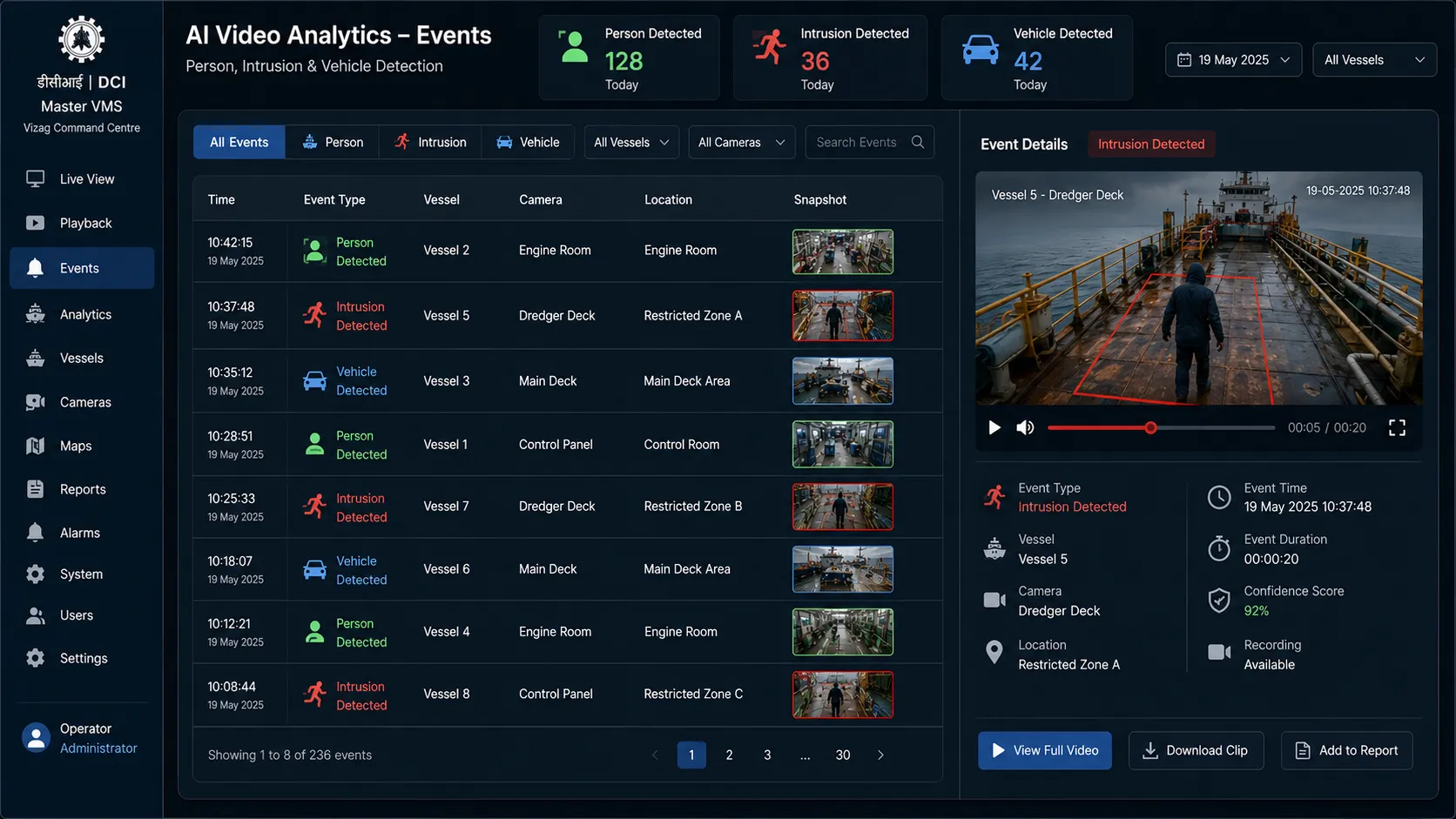
AI video analytics for person, intrusion and vehicle detection
Multi-Vessel Surveillance Coverage
- We deployed 18 4 MP IP cameras on each of the 8 vessels, providing a total of 144 cameras across the DCI fleet. The use of surveillance camera resolution helps support clear visibility and object identification across different surveillance distances.
- The cameras provide surveillance coverage across key operational areas, including:
- 1Engine room
- 2Control panel
- 3Dredger deck
- 4Operational areas
- 5Other designated critical zones
The camera placement was designed to provide visibility across important sections of each vessel. The combination of IP cameras, onboard VMS and local video analytics creates a vessel-level surveillance environment. The centralized architecture then connects these individual environments into one fleet-wide monitoring system.
Centralized Command Centre Monitoring
- The Vizag command centre acts as the central monitoring hub for all 8 vessels, enabling remote security monitoring across the fleet.
- Through the master VMS, authorized operators can:
- 1Monitor connected vessel cameras
- 2View live surveillance feeds
- 3Review analytics events
- 4Access vessel-level video
- 5Monitor multiple vessels from one interface
This centralized approach allows the DCI team to monitor distributed vessels without maintaining separate command centre operations for each vessel.
The master VMS provides a consolidated view of the connected surveillance infrastructure while preserving the local capabilities available onboard each vessel.
Remote Vessel Surveillance Connectivity
- The vessels communicate with the Vizag command centre through VSAT connectivity.
- Because maritime communication links can have bandwidth limitations, our architecture keeps video management and analytics local to each vessel. This reduces the dependency on continuously transmitting all raw video streams to shore.
- The approach combines:
- Local Processing + VSAT Connectivity + Centralized Monitoring
- This allows the system to maintain vessel-level surveillance capabilities while providing centralized visibility to the DCI team.
Deploying DCI Surveillance Solution
Katomaran Technologies implemented the solution across the 8 Dredging Corporation of India (DCI) vessels and the Vizag command centre.
The implementation included:
- Deployment of 18 4 MP IP cameras on each vessel.
- Installation of an onboard worker VMS server on every vessel.
- Configuration of local video recording and management.
- Implementation of person, intrusion and vehicle detection.
- Configuration of vessel-level VMS instances.
- Deployment of the master VMS at Vizag.
- Integration of vessel systems with the centralized platform.
- Establishment of VSAT-based connectivity.
- Testing of live viewing, recording, analytics, events and centralized monitoring.
This implementation brought the vessel-level surveillance systems together within a centralized architecture while maintaining local processing capabilities.
Surveillance Project Highlights
Our implementation delivered a unified surveillance environment across DCI’s vessel fleet.
Key outcomes include:
- 8 vessels monitored from one command centre
- 144 cameras connected across the fleet
- Local VMS and video processing onboard every vessel
- Centralized monitoring through the master VMS
- Remote surveillance through VSaaS
- Person, intrusion and vehicle detection
- Efficient use of VSAT connectivity
- Centralized access to distributed vessel surveillance
- Scalable architecture for future vessel expansion
AI-Powered Maritime Surveillance
- The DCI project demonstrates how VMS, VSaaS and AI Video Analytics can work together to support surveillance across geographically distributed maritime environments.
- We combined onboard VMS, local video analytics, VSAT connectivity and a centralized master VMS to enable DCI to monitor 8 vessels and 144 cameras from its Vizag command centre.
- Our master–worker architecture provides local video processing while maintaining centralized fleet monitoring. This approach creates a practical and scalable surveillance framework for vessels and other remote environments where connectivity can be constrained.
Table of contents
Planning a Similar Multi-Vessel Surveillance Project?
Katomaran Technologies provides integrated VMS, VSaaS, AI Video Analytics and centralized surveillance solutions for maritime, industrial, infrastructure and geographically distributed environments.
Discuss Your Project