
Industry
Steel Castings / Foundry
Duration
3 months
Team Size
4 people
Overview
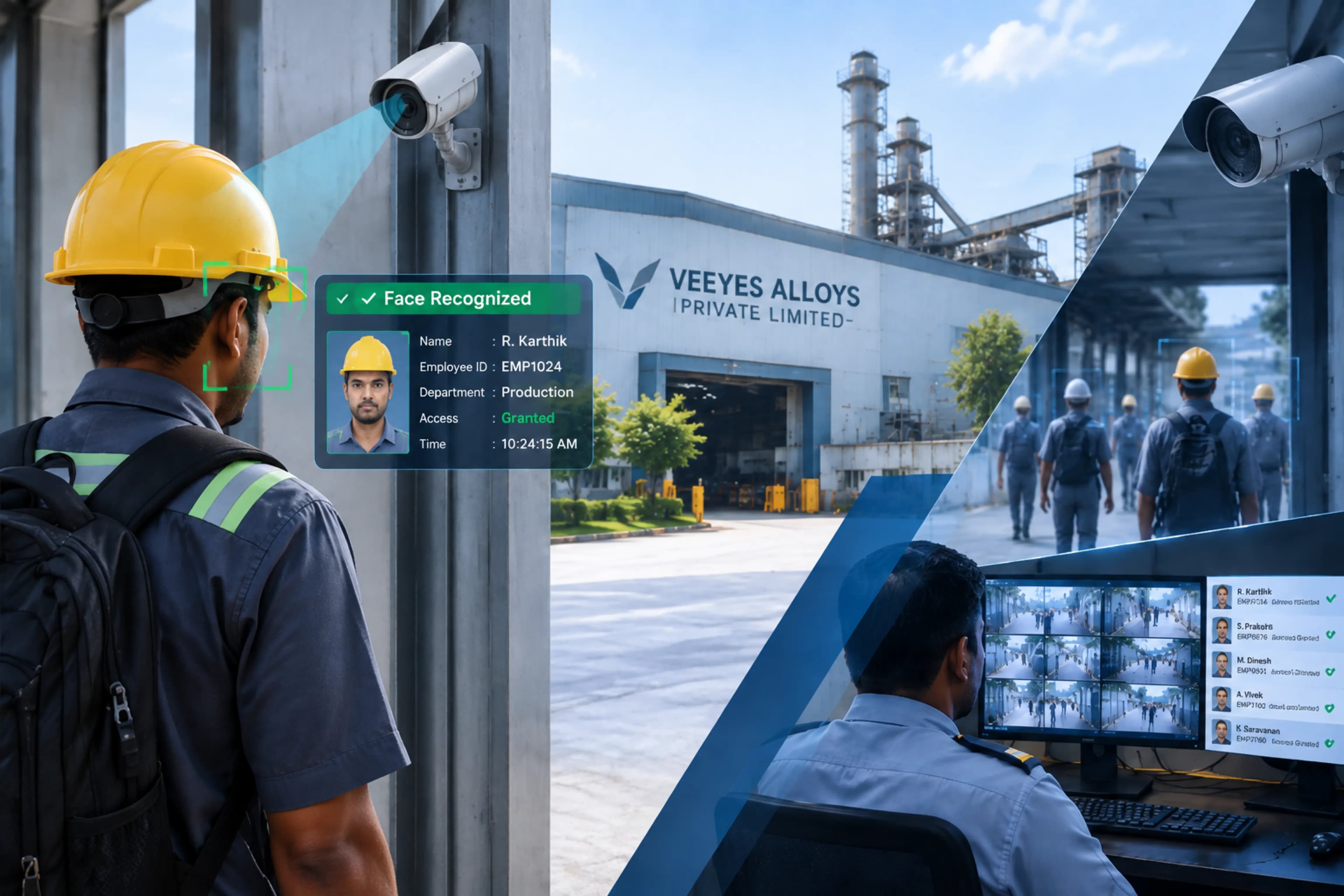
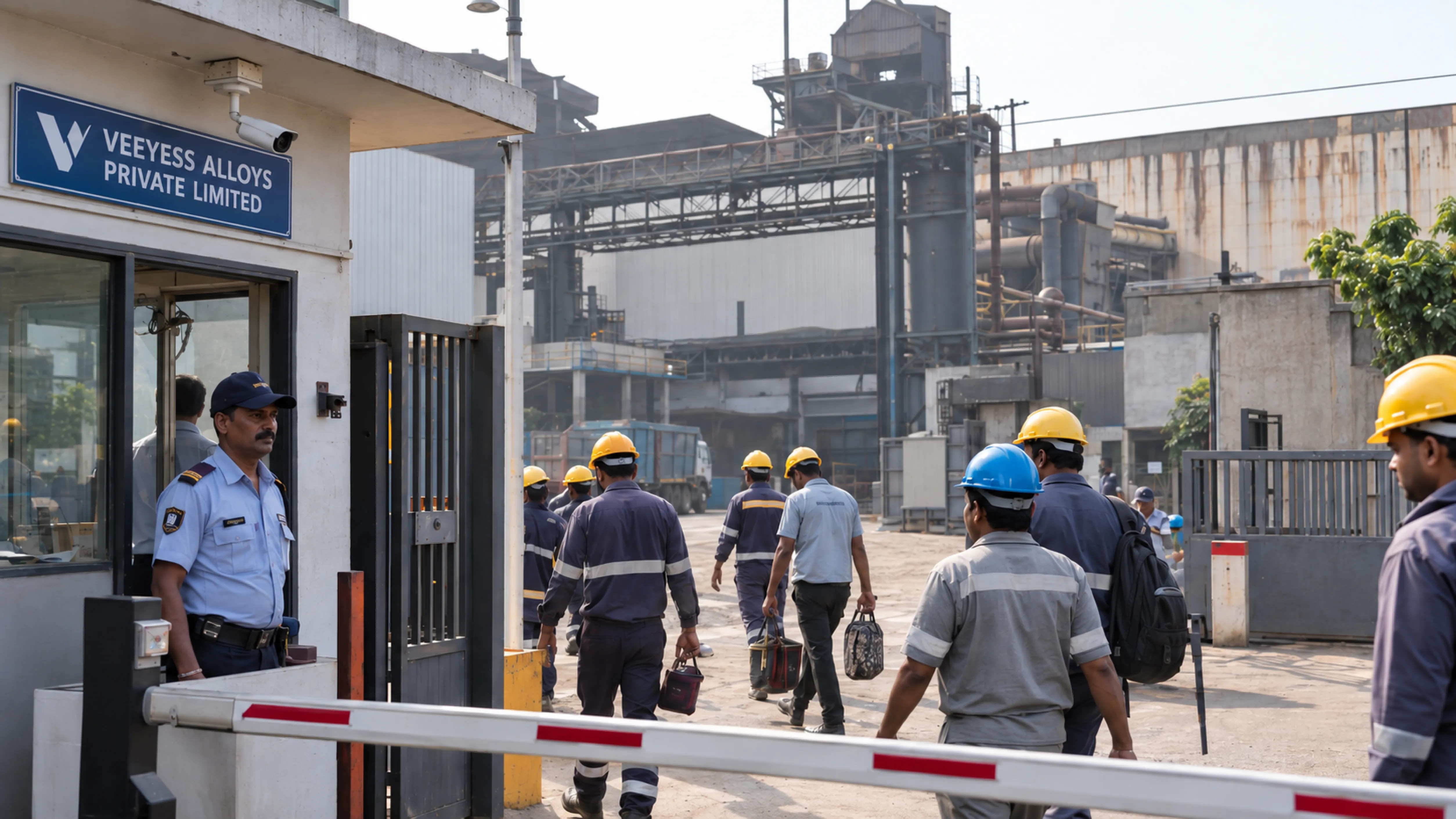
VEEYES Alloys operates a steel castings and foundry facility in Coimbatore, Tamil Nadu, working with carbon steel, alloy steel, stainless steel, and duplex and nickel-based alloys. As part of strengthening attendance accuracy and gate-level access control, the facility engaged Katomaran Technologies to implement a Face Recognition System (FRS) across its front and back gates. The deployment pairs dedicated entry and exit cameras with attendance marking that follows the facility's shift schedule, giving both operations and security teams a single, connected view of employee movement. By anchoring attendance to the gates employees actually use, the system reduces reliance on separate manual processes at each checkpoint.
Face recognition attendance at Veeyes Alloys gate
Quick Snapshot
| Parameter | Details |
|---|---|
| Client | VEEYES Alloys |
| Industry | Steel Castings / Foundry |
| Application | Industrial Attendance & Access Control |
| Core System | Face Recognition System (FRS) |
| Operation Mode | Shift-based Attendance |
Industrial Attendance Tracking Challenges
- Foundries and casting facilities typically operate across multiple shifts, with employees, contractors, and staff moving in and out through more than one gate over the course of a day. Tracking this movement accurately, and tying it back to the correct shift, becomes difficult when attendance depends on manual registers, punch cards, or standalone systems that aren't connected to actual gate activity.
- In this kind of multi-shift, multi-gate environment, the front and back gates are often managed as two separate checkpoints, each with its own record-keeping approach. Without a common system linking the two, it becomes harder to build a complete, accurate picture of who is on site at any given time, and harder still to reconcile that picture against shift schedules.
Common challenges in this type of environment include:
- Manual attendance registers being time-consuming to maintain and prone to data-entry errors
- Buddy punching or proxy attendance being difficult to rule out with card- or PIN-based systems
- Entry and exit records not always matching up, making it hard to confirm actual time spent on site
- Coordinating attendance across multiple shifts and shift changeovers without a consistent, centralized process
- Front and back gates being tracked separately, with no unified view of who has entered or exited through either point
- Limited real-time visibility for the security or HR team into entry and exit activity as it happens
- Attendance data spread across separate tools or paper records, making it harder to review activity for a specific shift as a whole
Face Recognition System Solution
- Katomaran's approach for VEEYES Alloys centered on deploying a Face Recognition System across both gates used by employees, replacing manual and card-based tracking with contactless identification tied directly to shift timings. Rather than treating entry and exit as separate, disconnected checkpoints, the system was structured around the facility's actual layout the front gate for entry, and the back gate for exit with cameras dedicated to each.
- This gate-level design means attendance is captured at the actual point of movement rather than at a separate check-in desk or standalone terminal. Because the same system covers both gates, entry and exit activity from either point feeds into one attendance record, rather than two disconnected logs that need to be manually reconciled.
- The deployment was built around four core elements: coverage across both gates, attendance marking aligned to shifts, contactless identification for employees, and centralized monitoring of all entry and exit activity. This follows the same gate-level design thinking that runs through Katomaran's AI-driven safety and monitoring solutions for manufacturing facilities, where identification and monitoring are treated as one connected layer rather than separate tools bolted onto existing gate processes.
Dual-Gate Face Recognition Coverage
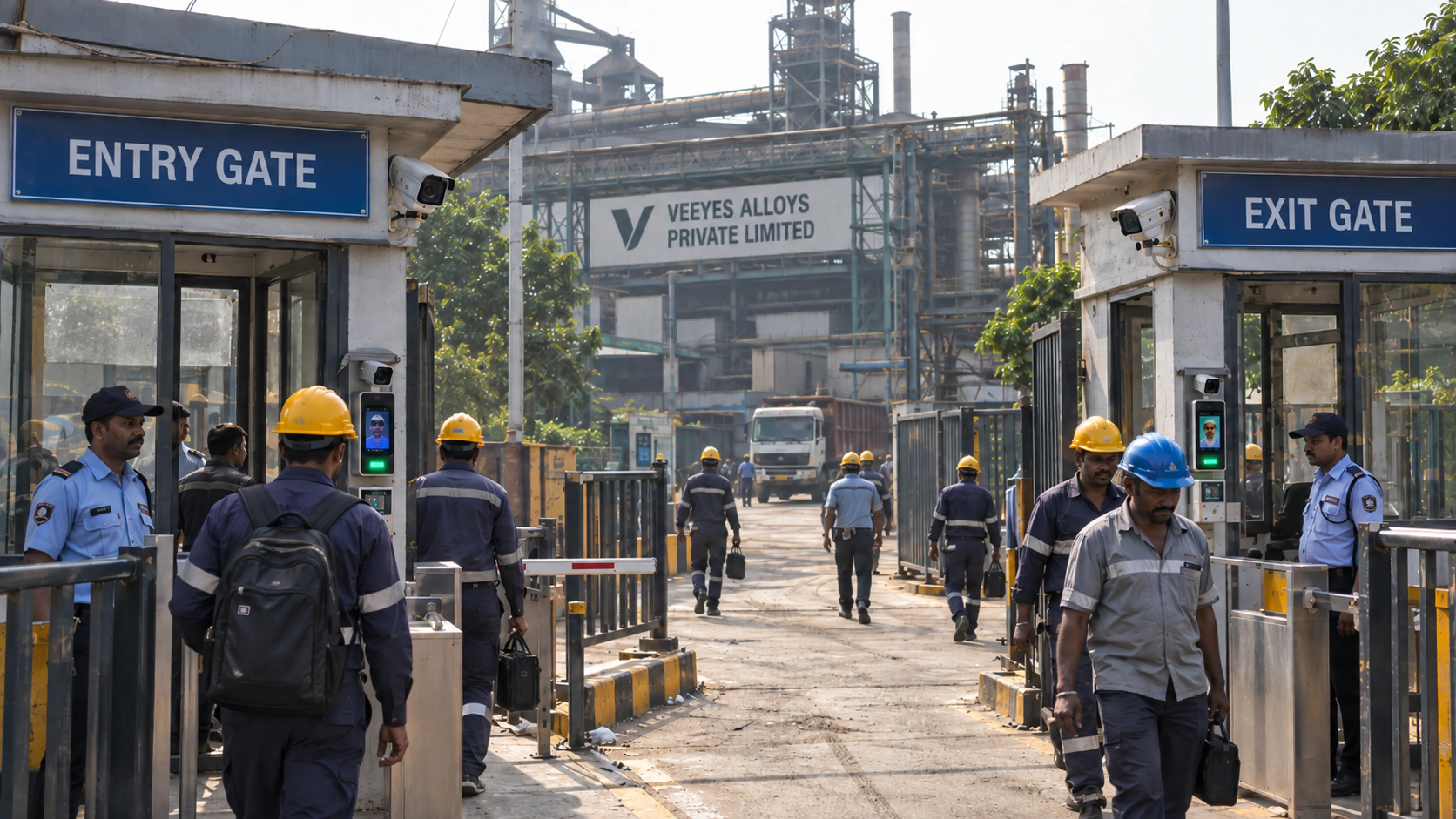
- Cameras deployed at the front gate to capture employee entry
- Cameras deployed at the back gate to capture employee exit
- Entry and exit are tracked separately by gate, giving a clear, gate-specific record of movement
- Coverage at both gates means employees are identified at whichever point they use, rather than only at a single designated entrance
- The dual-gate setup reflects the facility's actual flow of employees rather than assuming a single point of movement
- Both gates are covered by the same FRS deployment, so entry and exit data are captured under one consistent system rather than two independent setups
Dual-gate employee face recognition
Shift-Based Attendance System
- Attendance is marked in line with the facility's defined shift timings
- Entry and exit events recorded through the FRS are tied to the relevant shift
- Shift-based operation supports consistency across multiple working shifts rather than relying on a single fixed schedule
- Attendance records reflect actual gate activity captured by the cameras, rather than manually entered timings
- The same shift logic applies uniformly across both the front and back gates
- Aligning attendance to shift timings helps keep records consistent for employees working across different shift patterns
Contactless Face Recognition Entry
- Employees are identified through face recognition rather than physical cards, badges, or manual sign-in sheets
- Identification happens as employees approach the gate, without requiring a separate check-in step or additional device
- Contactless identification reduces dependency on physical credentials that can be lost, shared, or misused
- The same identification method is applied consistently at both the front and back gates, so employees experience the same process at either point
- Removing manual sign-in from the process reduces the potential for entry errors at busy shift-change periods
- Identification through face recognition also removes the need for employees to carry or present anything at the gate
Centralized FRS Attendance Monitoring
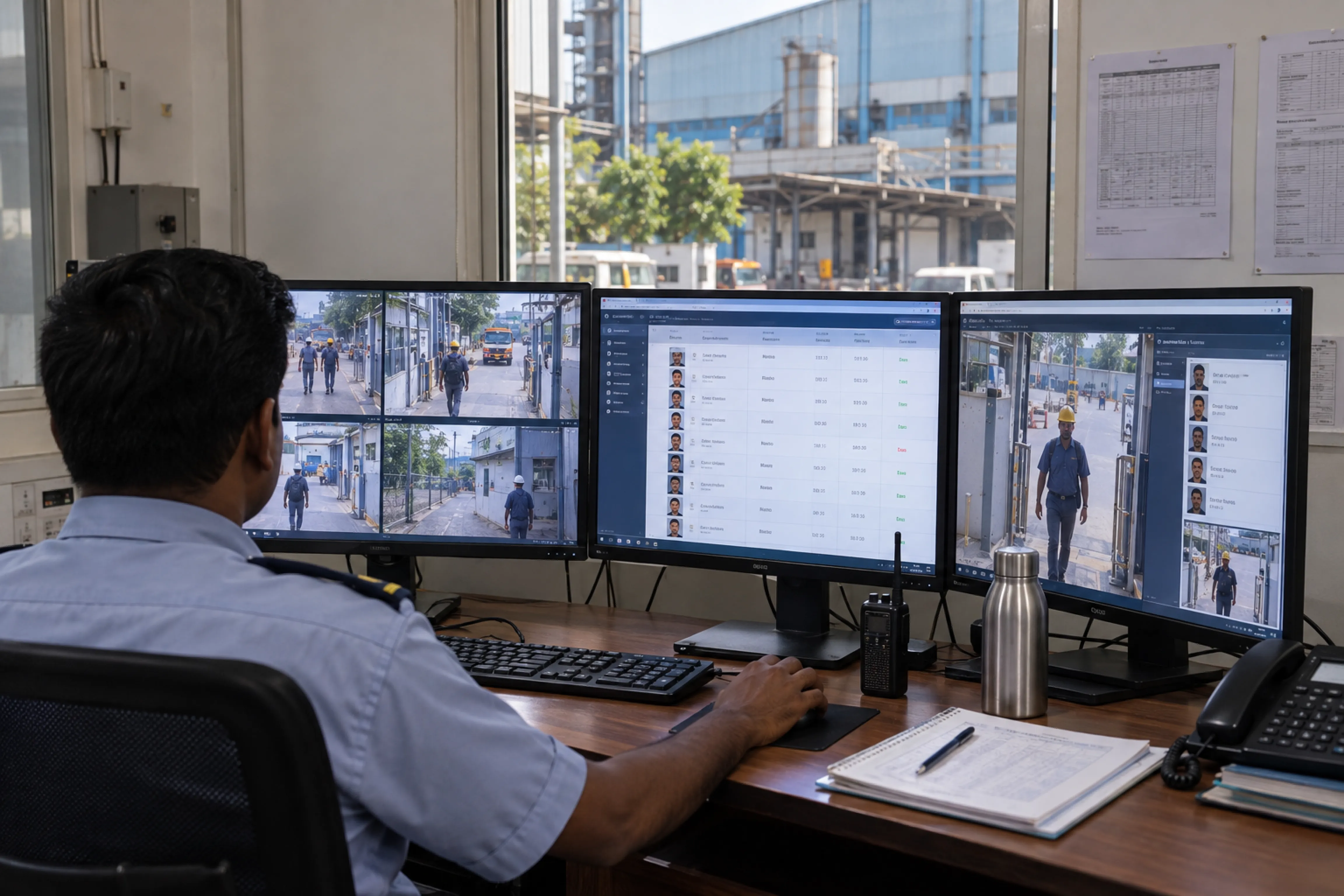
- Entry events from the front gate and exit events from the back gate are brought into a common view
- Security and HR teams can review attendance and gate activity from one place rather than checking each gate separately
- Centralized monitoring supports a clearer, more consistent record of movement across the facility
- The setup ties gate-level activity directly to shift-based attendance records, keeping both in sync
- A single point of review simplifies day-to-day oversight compared to managing two independent gate systems
- Reviewing both gates together also makes it easier to spot gaps between entry and exit records for a given shift
Centralized FRS attendance monitoring
How the System Works
- An employee approaches the front gate at the start of a shift
- The FRS cameras at the front gate capture the employee's face and match it against the registered profile
- Once identified, the system logs the entry event against the employee's record
- The entry event is marked as attendance for the current shift based on the facility's defined shift timings
- Over the course of the shift, entry activity at the front gate continues to be logged in the same way for each employee
- At the end of the shift, the employee moves through the back gate for exit
- The FRS cameras at the back gate capture and identify the employee, logging the exit event
- Entry and exit records from both gates are brought together into a single shift-based attendance record for each employee
- Security and HR teams can review entry, exit, and attendance activity for either gate through centralized monitoring
- Over time, this gives the facility a consistent, gate-verified attendance history for each employee across all shifts worked
Key Capabilities Delivered
- 1Face Recognition System deployed across two gates front entry and back exit
- 2Dedicated cameras at the front gate for entry identification
- 3Dedicated cameras at the back gate for exit identification
- 4Shift-based attendance marking tied to actual, camera-captured gate activity
- 5Contactless identification for employees entering and exiting the facility
- 6Consistent identification process applied uniformly at both gates
- 7Centralized monitoring of entry and exit events across both gates
- 8A connected attendance process that replaces manual or card-based tracking at the gate level
FRS Attendance Outcome
- With a Face Recognition System covering both the front and back gates, VEEYES Alloys now has a more connected way to track employee movement and attendance across shifts. Entry and exit events are captured directly at the gate rather than relying on manual registers or separate card-based checks, giving the facility cleaner, more consistent attendance records that are easier to reconcile against actual shift activity.
- Bringing both gates into a single, centralized process also gives the security and HR teams clearer visibility into who has entered or exited the facility at any point in a shift, reducing the coordination effort that comes with managing attendance across multiple gates and shift changeovers manually. This approach reflects the same gate-level thinking behind Katomaran's other face recognition deployments for factory access control, and sits alongside its broader work on AI-driven safety and monitoring solutions for manufacturing facilities, all supported by a centralized video management system that keeps entry, exit, and monitoring data in one place. It follows the same pattern seen across Katomaran's broader set of industrial and enterprise case studies, applied here to VEEYES Alloys' dual-gate foundry environment.
Table of contents
Looking to Implement Face Recognition for Industrial Attendance?
Katomaran Technologies provides AI-powered Face Recognition Systems, dual-gate access control, and shift-based attendance tracking tailored for manufacturing plants and industrial facilities.
Talk to Our Experts