Introduction
A highway corridor doesn't behave like a city junction. Traffic moves faster, incidents matter more when they happen, and there's often no one physically present to see a violation or a stalled vehicle until it's already caused a queue behind it. An ITMS on a highway corridor exists to close that gap: speed violations, wrong way movement, and incident events all need to be caught and acted on quickly, across stretches of road where staffing every kilometer with personnel was never realistic.
The Monitoring Challenge on Highway Corridors
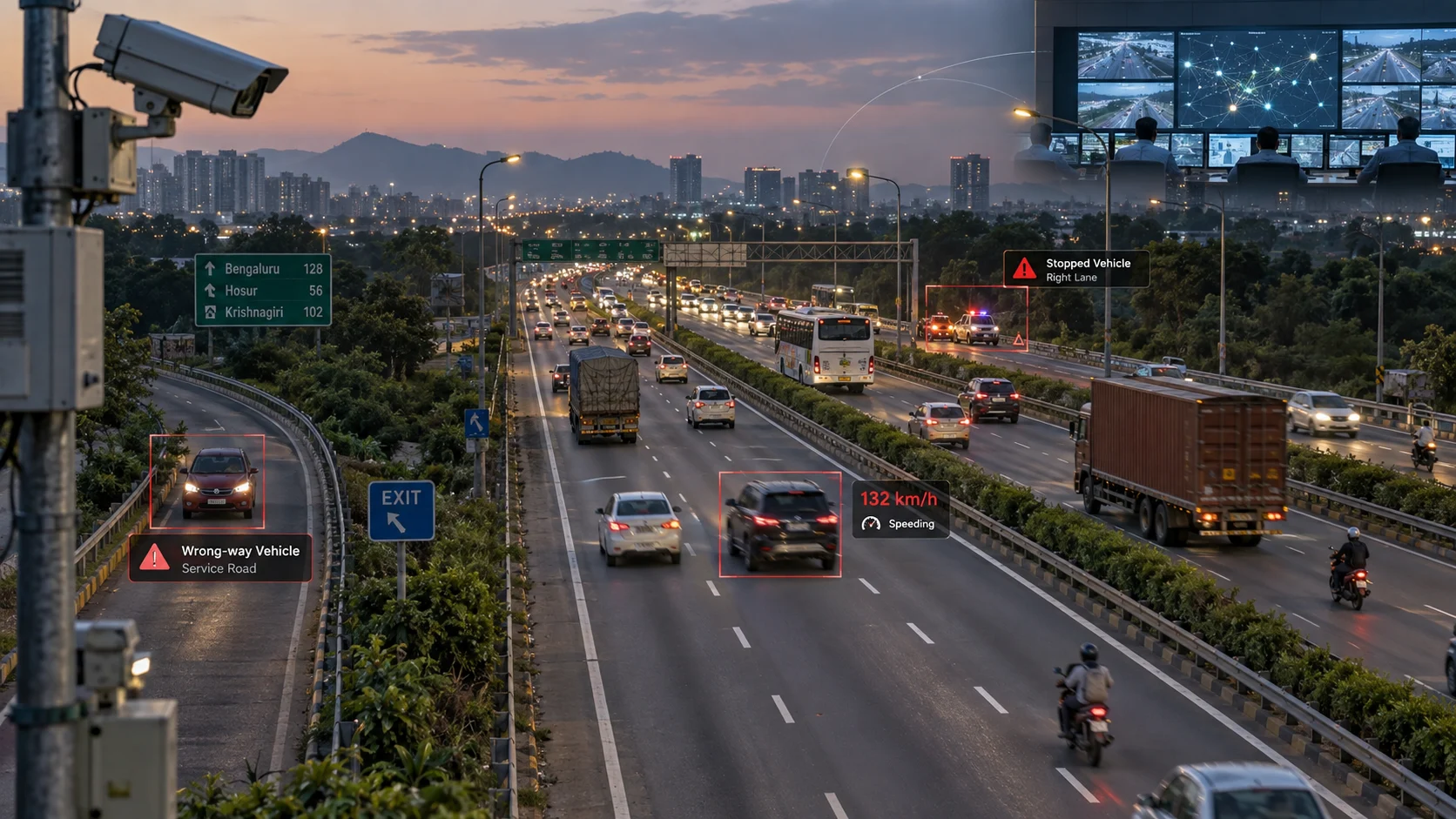
A city intersection has a natural chokepoint: vehicles slow down, queue, and pass through a relatively contained space that a camera or an officer can cover. A highway corridor has none of that. Traffic moves at speed across long, often unlit stretches, and an incident anywhere along tens of kilometers can go unnoticed for minutes, sometimes longer, unless something is actively watching that specific stretch of road.
Fixed cameras placed at intervals help, but coverage gaps are common on older corridors, and even where cameras exist, someone has to be watching a live feed for a violation or an incident to be caught in time. A control room operator monitoring a dozen highway camera feeds faces the same attention limits as any control room operator does. What changes on a highway corridor is the consequence of a missed event: a wrong way vehicle or a stalled truck in a live lane at speed is a safety risk measured in seconds, not minutes.
What an ITMS Brings to Highway Operations
An ITMS adds three things fixed cameras can't provide on their own: continuous automated monitoring that doesn't depend on someone watching the right feed, a shared record that links events from different points along the same traffic stream, and a direct path from detection to alert and, where needed, enforcement.
The corridor shifts from one where footage is reviewed after something has gone wrong to one where speeding, wrong-way vehicles, and stopped vehicles are flagged as they happen. That matters most where staffing is hardest: remote stretches, night hours, and weather that degrades both visibility and attention. These are the same conditions covered in how ITMS supports speed and violation monitoring on smart highways.
Speed Violation Detection on Highways
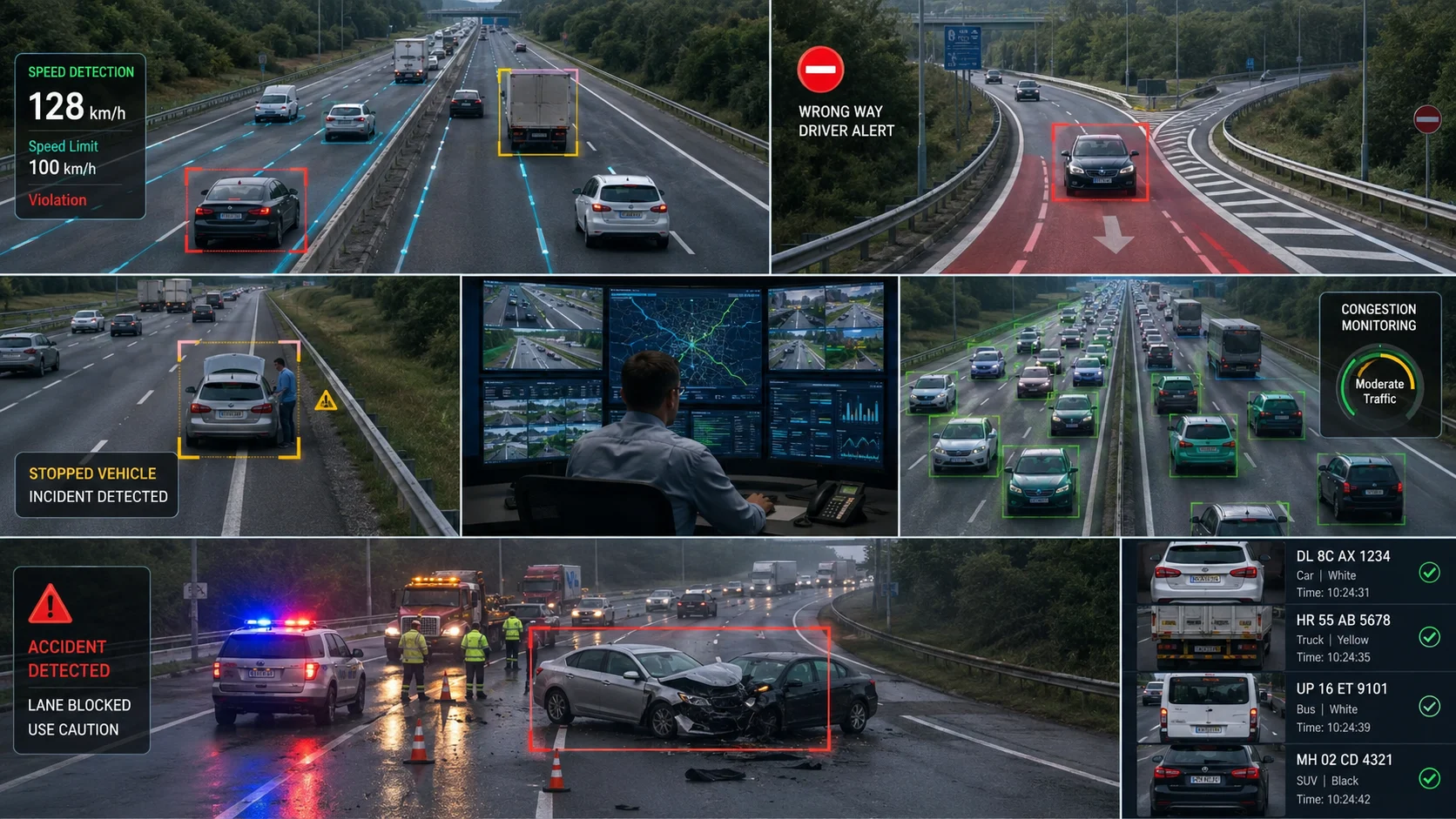
Speed violation detection highways deployments typically use one of two approaches. Point speed detection measures a vehicle's speed at a single location, usually with a radar or camera pair at a fixed spot, and flags anything over the limit at that point. Section based speed monitoring measures average speed between two points a known distance apart, using ANPR to match the same vehicle at both ends and calculate speed from time and distance.
Section based monitoring tends to reflect actual driving behavior better, since a vehicle can't simply slow down for a single camera and speed up again right after. It needs reliable number plate recognition at both ends of the section and a stable time reference between them, which becomes a real engineering constraint on long corridors with variable network conditions. For evidence purposes, ANPR speed enforcement needs to produce a clear, time stamped, geotagged record that can support a legal challenge, not just an internal flag, a point covered in more depth in how ANPR pairs with the enforcement workflow end to end.
Detecting Wrong Way Driving
Wrong way driving detection watches a defined direction of travel on a lane or carriageway and flags any vehicle moving against it. On divided highways this is usually a clear violation with an obvious cause, most often a driver entering from the wrong ramp or ignoring a median break meant for official or emergency use. On undivided stretches, where opposing traffic legitimately shares the same road width, the detection logic has to be more precise about what counts as a violation versus a vehicle briefly using the shoulder or crossing to a side road.
The safety case for this specific capability is straightforward: a wrong way vehicle at highway speed is one of the more dangerous events a corridor can have, and the warning window between detection and a possible collision is short. An alert needs to reach both the control room and, ideally, nearby variable message signage or field teams within seconds, not sometime later during a routine review of footage.
Incident and Abnormal Event Detection
Beyond speed and direction, an ITMS watching a highway corridor typically looks for a handful of other event types: a stopped or stalled vehicle in a live lane, debris or an obstruction on the carriageway, sudden congestion building at a point where traffic normally flows freely, and abrupt stops or impacts consistent with a collision.
None of these are single frame detections. A stopped vehicle needs to stay stopped for some defined duration before it's flagged, to avoid raising an alert for a vehicle simply slowing in traffic. Congestion detection needs a baseline of what normal flow looks like at that location and time of day to recognize a meaningful deviation. Highway incident detection depends as much on tuning to the specific corridor as it does on the underlying video analytics, since a threshold that works well on one stretch can generate excessive false alerts on another with different traffic patterns, a subject covered in more depth in how intelligent traffic management detects accidents and speeds up response.
How the Components Work Together
None of these capabilities work in isolation in a well designed deployment. A speed violation and a wrong way alert from the same stretch of road, close together in time, might indicate a single vehicle causing both, which changes how a control room should prioritize the response. Incident detection at a location that also has recent speed violation data can help responders understand what likely happened before they arrive.
This coordination depends on all the components feeding into the same platform rather than running as separate, disconnected systems from different vendors. Where highway corridors already have CCTV or older traffic sensors installed, integrating that existing camera infrastructure into a unified ITMS rather than replacing it outright is usually the more practical starting point, both for cost and for how quickly a corridor can actually go live.
Practical Considerations for Indian Highway Deployments
Indian highway corridors add a set of conditions that shape what's realistic. Mixed traffic at high speed is the most obvious: trucks, buses, cars, and two wheelers share the same carriageway with very different speed profiles and lane discipline, which affects how detection zones and thresholds need tuning compared to a corridor with more uniform traffic.
Lighting and weather vary significantly along a single corridor, let alone across regions. Cameras need to perform in daylight glare, at night with vehicle headlights as the main light source, and through monsoon conditions where visibility and lens clarity both degrade. Power and network reliability at remote stretches, away from towns and substations, is often the harder engineering problem; local processing with store and forward behavior tends to hold up better than a design that assumes constant connectivity to a central system.
Existing infrastructure is rarely uniform either. Many corridors already have cameras or sensors installed by different vendors over different years, and an ITMS layered on top needs to work with that reality rather than assume a single, modern camera estate from day one. For broader context on how these systems support enforcement outcomes, the road safety case for ITMS and where AI adds the most value in traffic management are both worth reading alongside this.
Closing Thoughts
On a highway, ITMS works best when it's treated as a set of coordinated functions rather than a single technology. Speed detection, wrong-way monitoring, and incident detection each solve a specific problem, but they're far more useful feeding one platform than running as separate systems on the same stretch of road.
For a highway authority or operator assessing a corridor, a practical first step is a survey of what's already there: existing cameras and sensors, and the power and network availability along each section of the route. If you're planning that assessment, we'd be glad to walk through it with you.

Frequently Asked Questions
1. Can an ITMS use the cameras a city already has?
Partly. Existing surveillance cameras usually work well for incident detection and traffic state monitoring. ANPR and seat belt detection need dedicated, correctly angled cameras, so we assess each location before reusing hardware.
2. How does the system handle an unreadable plate or a poor night image?
It routes the record to manual review. An operator checks every uncertain case before a challan is issued, because weak reads create disputes. Rejected events remain logged, so the audit trail stays complete.
3. What happens when network connectivity drops at a junction?
A well-designed edge unit keeps detecting and stores evidence locally until the link returns, then forwards it in sequence. Local storage should be sized for the longest outage that site realistically experiences.
4. How is red light violation detection made reliable?
Signal state should come directly from the signal controller. Reading signal lamps from video is vulnerable to glare and faded lenses. The evidence then records the signal phase alongside the vehicle's position at the stop line.
5. Does an ITMS replace traffic police on the road?
No. It changes where officers spend their time. The system handles repetitive roadside documentation, leaving officers free for incidents, congestion management, and situations that need judgment. Enforcement decisions remain with the authority.
6. Which locations should an authority cover first?
Start where crash records and public complaint data point, often high-speed corridors and complex junctions. Early sites also reveal local lighting and connectivity problems before a wider rollout begins.

Caldwell Simon
Project Manager
Caldwell Simon, Project Manager at Katomaran Technologies, writes on AI video analytics, VMS, IoT integration, and large-scale surveillance deployment and delivery.