Introduction
When it comes to modern surveillance, darkness is no longer a limitation—but how effectively objects are detected in the dark depends on the illumination technology used. Object detection in pitch darkness is a critical requirement across smart cities, industrial security, traffic monitoring, and enterprise surveillance systems.
This blog focuses on object detection in zero-light or pitch-dark conditions, where no ambient light is available. In such environments, standard cameras rely entirely on external illumination to capture usable visual data.
Two primary technologies—Infrared (IR) and Floodlight (White Light)—are widely used to enable visibility in complete darkness. While both make surveillance possible, they differ in how they capture scenes, influence image characteristics, and support detection and analysis. Both approaches come with their own advantages and limitations, depending on the use case and environment.
In this blog, we compare IR and floodlight illumination to understand how each performs in complete darkness and where each is best suited for object detection.
Object Detection Challenges in Pitch Darkness
In pitch darkness or zero-light environments, object detection becomes significantly more complex. Unlike low-light scenarios, there is absolutely no visible light available for image capture.
This leads to key challenges:
Absence of visible light for image capture
Limited visual information for analysis
Potential reduction in image clarity and contrast
Impact on the consistency of AI-based detection and classification
To overcome these challenges, illumination technologies act as the “eyes” of surveillance systems, enabling cameras and analytics engines to function effectively even in total darkness.
Understanding these challenges helps in evaluating how both IR and floodlight illumination address them differently, each with its own strengths and trade-offs.
What is IR Illumination?
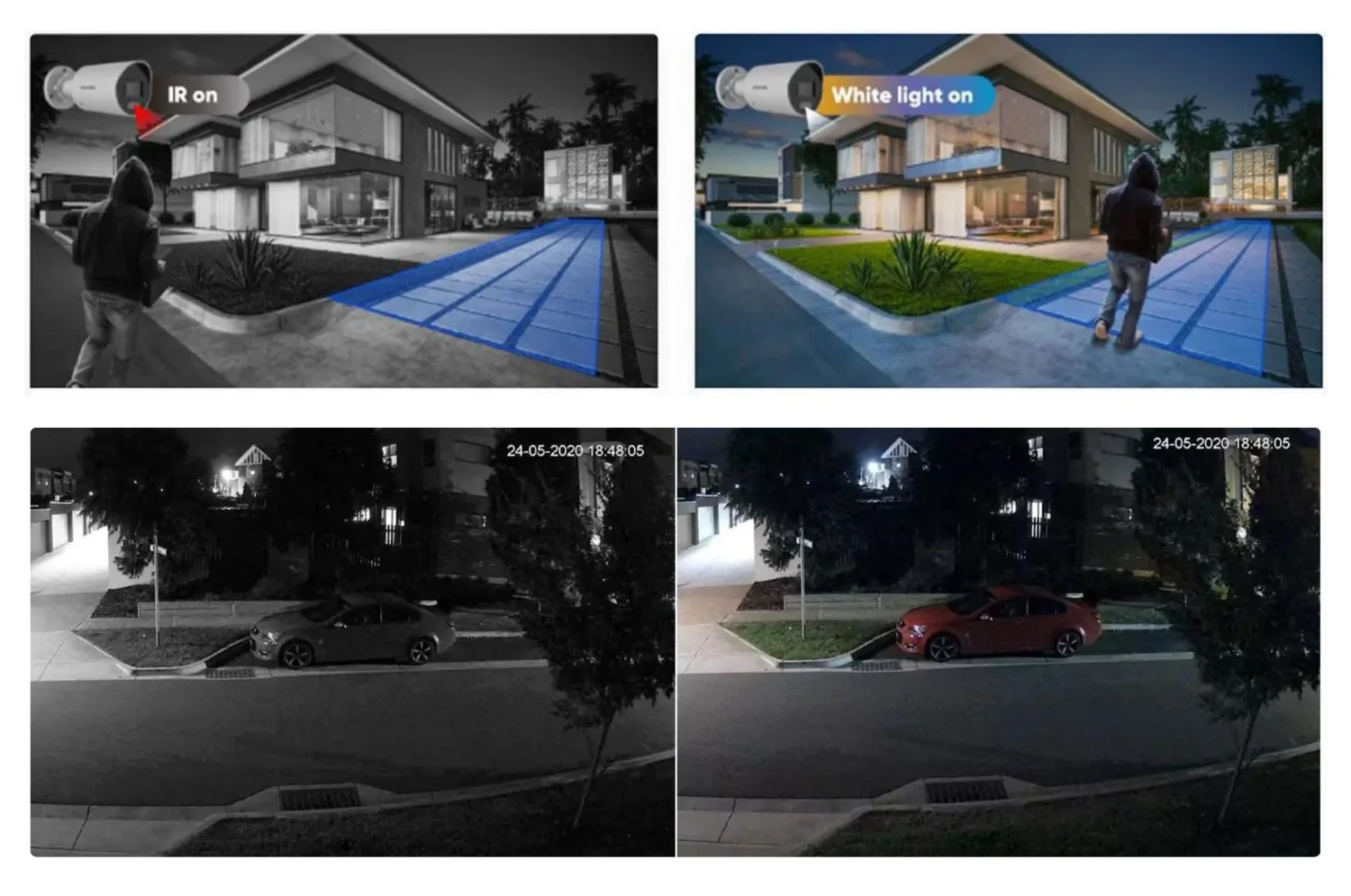
Infrared (IR) illumination uses non-visible light wavelengths that camera sensors can detect, even in complete darkness. Most surveillance cameras automatically switch to IR mode when lighting conditions drop to zero.
In pitch-dark conditions, IR enables visibility without emitting visible light, making it suitable for discreet monitoring. However, the output is typically black-and-white, as IR does not capture color information.
How IR Performs in Complete Darkness
In zero-light environments, IR illumination provides consistent and reliable visibility for object detection:
Advantages:
Enables detection of movement and object presence even in complete darkness
Operates without visible light, supporting discreet surveillance
Suitable for continuous, long-duration monitoring
Typically consumes less power compared to visible lighting systems
Considerations:
Does not capture color information, which can limit detailed classification
Fine details such as facial features or vehicle attributes may be less distinguishable
Performance can vary over longer distances, depending on camera capability
Reflective surfaces may influence image clarity in certain environments
IR is well-suited for scenarios where continuous monitoring and unobtrusive operation are priorities, even if detailed identification is not always required.
What is Floodlight Illumination?
Floodlight illumination uses visible white light to illuminate the environment, allowing cameras to capture scenes in conditions similar to daylight. Unlike IR, it introduces visible lighting into the scene, enabling color image capture.
In pitch-dark environments, floodlights improve scene visibility for both human monitoring and video analytics systems.
How Floodlight Performs in Complete Darkness
Floodlight illumination enhances visibility by lighting up the scene in zero-light conditions:
Advantages:
Enables full-color image capture for improved visual interpretation
Enhances clarity, contrast, and scene detail
Supports more detailed analysis for both human operators and AI systems
Can cover wider areas depending on light placement and intensity
Considerations:
Higher power consumption compared to IR, especially for continuous use
Bright lighting may introduce glare or shadows in certain conditions
Not ideal for discreet or covert surveillance scenarios
External factors, such as insects or environmental conditions, may influence performance
Floodlight is particularly useful in scenarios where visibility and identification are important, especially during specific events or monitored activities.
IR vs Floodlight: A Practical Comparison
The comparison below evaluates both technologies in complete darkness, highlighting how they differ based on use-case needs:
| Parameter | IR Illumination | Floodlight Illumination |
|---|---|---|
| Visibility | Works in complete darkness with black-and-white output | Illuminates the scene with visible light, enabling color images |
| Image Quality | Provides consistent visibility, though with limited detail and no color | Offers higher detail and color, depending on lighting conditions |
| Object Detection Accuracy | Reliable for detecting presence and movement | Supports improved classification with richer visual data |
| Identification Capability | May be limited for fine details | More suitable for identifying visual attributes |
| Surveillance Type | Discreet and non-intrusive | Visible and can influence surroundings |
| Range Performance | Effective based on the IR range and camera capability | Depends on light intensity and placement for coverage |
| Environmental Impact | Less affected by visible disturbances, but sensitive to reflections | Improves visibility but may attract insects or cause light glare |
| Power Consumption | Lower power usage | Higher power usage, especially when always on |
| Use Case Suitability | Suitable for continuous monitoring in zero-light areas | Suitable for scenarios requiring enhanced visibility and detail |
| AI Analytics Performance | Supports basic analytics depending on contrast | Enhances analytics with more visual information, if lighting is well-managed |
Use Case-Based Recommendations for Zero-Light Environments
Choosing the right illumination depends on how object detection needs to function in pitch darkness:
In industrial and warehouse environments, IR is commonly used for continuous monitoring in completely dark zones, while floodlights may be applied in key areas where additional visibility is required.
For smart city and traffic applications, both IR and floodlight play important roles—IR supports uninterrupted monitoring, while floodlight can assist in scenarios requiring clearer visual details.
Residential and perimeter security systems often benefit from a hybrid approach, using IR for ongoing surveillance and activating floodlights when enhanced visibility is needed.
In high-security environments, the choice depends on whether the priority is continuous monitoring (IR) or detailed identification during specific events (floodlight).
The Rise of Hybrid Illumination Systems
Modern surveillance systems are evolving beyond single-mode operation. Hybrid illumination systems combine IR and floodlight technologies to balance performance in pitch darkness.
These systems typically:
Use IR for continuous monitoring in complete darkness
Activate floodlights when motion or specific events are detected
Balance energy efficiency with improved visibility when required
This approach allows systems to adapt to different conditions while leveraging the strengths of both technologies.
Enhancing Object Detection with AI in Pitch Darkness
In zero-light environments, illumination and AI must work together. Advanced surveillance systems use intelligent illumination control alongside AI analytics to improve detection outcomes.
These systems can:
Adjust lighting dynamically based on scene conditions
Improve detection accuracy through better visual input
Reduce false alarms by enhancing image clarity
Provide actionable insights even in complete darkness
The combination of adaptive illumination and AI enables more reliable performance across varying lighting conditions.
Conclusion
Object detection in pitch darkness depends on aligning illumination technology with the environment's specific needs. IR enables consistent and discreet monitoring, while floodlight improves visibility and supports more detailed interpretation.
Rather than one being universally better, both technologies offer distinct advantages and come with their own limitations. Their effectiveness depends on factors such as monitoring goals, environmental conditions, and operational priorities.
In many real-world scenarios, combining IR and floodlight provides a balanced approach—ensuring continuous monitoring while enabling detailed visual information when required.
Katomaran’s intelligent surveillance solutions integrate advanced video analytics with adaptive illumination technologies, enabling reliable object detection across a wide range of lighting conditions, including complete darkness.

Kavinpradeep
Digital Marketer
Kavinpradeep is a Digital Marketer at Katomaran Technologies, creating content on AI video analytics, VMS, IoT, and intelligent surveillance technologies for real-world use.