HomeAboutServicesProductsIndustriesSoftware Development Agency BangaloreSoftware Development Company IndiaCase StudiesBlogsContactCareersSitemapGenerative AIVideo AnalyticsMobile App DevelopmentWeb App DevelopmentUI/UX DesignIoT DevelopmentVideo Management SystemVideo AnalyticsVSaaSFace RecognitionIntelligent Traffic Management SystemConstruction SolutionsCritical InfrastructureManufacturing SolutionsSmart Cities SolutionsMining SolutionsRetail SolutionsWarehouse SolutionsHealthcare SolutionsAir Quality Monitoring AppAi Anpr Traffic Management SingaporeSmart Facility Portal SingaporeCar Rental Platform OmanSmart Laboratory BenchCondo App Gated Community SingaporeAi Inventory Forecasting Operations PlatformSmart Kitchen EcosystemAi Powered Tire InspectionAI Video Analytics Mining OperationIoT Fume Hood Automation SystemCorporate AI Video SurveillanceAI Powered Document AnalyzerAI Powered Remote Security Monitoring SystemAI Video Analytics Case Study for ManufacturingFRS for VIP Security: Blacklist & Criminal IdentificationHow ODS and CIDS Are Transforming Safety in Modern Metro Rail NetworksFrom CCTV to Cognition: Airport Use Case for Facility Intelligence InfrastructureComprehensive Video Search in VSaaS Platforms for InvestigationHow Forklift Safety Systems with Video Analytics Reduce Workplace InjuriesPPE Detection: Transforming Workplace Safety in the Modern EraThe Impact of Dynamic DNS to Replace Static IP in VSaaS PlatformsIoT in Warehousing: Smart Automation for Faster OperationsDepth Estimation in Cameras Using Stereo Vision and AIAI-Powered FRS vs Traditional Access Cards: What Industries Should KnowHow IoT Improves Visitor & Vehicle Movement Tracking in Industrial CampusesWhy Every Industry Needs Video Analytics for Safety & EfficiencyTop 10 Use Cases of FRS Across Industries in 2025Top 10 Use Cases of AI Video Analytics in Modern Metro SystemsVideo Analytics for Retail: Transforming Stores with Real-Time IntelligenceHow Cloud-Based Surveillance (VSaaS) Improves Student SafetyTop 7 Reasons Businesses Are Switching to VSaaS for Security7 Smart Video Analytics Applications Every Hospital Should HaveHow VSaaS Reduces Security Costs Without Compromising SafetyHow Video Analytics Improves Security Monitoring in Airports and Transportation HubsVSaaS in Transportation: Smarter Surveillance for Stations and DepotsHow Mobile VSaaS Apps Are Redefining Security for SMEs and EnterprisesTop 10 Reasons Why Your Business Needs a Mobile App: Key Benefits ExplainedHow AI Video Analytics Detects Weapons, Fights, and Suspicious Activity in Real TimeThe Role of IoT in Intelligent Traffic Management SystemsWhy Forensic Video Analytics Is Becoming a Must-Have for Security AgenciesVideo Analytics for Oil and Gas FacilityWhat is VSaaS (Video Surveillance as a Service)?Top 5 Reasons to Choose Custom Mobile App DevelopmentWhy Small Language Models Might Be the Future of AI AgentsHow a Face Recognition System Works for Attendance ManagementIntelligent Traffic Management Systems for Road Safety EnhancementVMS vs VSaaS: Which is Right for Your Business?Benefits of Implementing AI in Intelligent Traffic Management SystemsIoT App Development: Basics and Key BenefitsTop 15 Real-World Use Cases of Video Analytics for BusinessesThe Future of AI: How Large Language Models are Transforming IndustriesWhat is Generative AI Development? A Complete Guide in 2025STQC certification in software development: why trust, quality, and compliance matter so muchAI Video Analytics in Airport Fuel FacilitiesHow AI & IoT Are Transforming Air Monitoring in Indian CitiesWhy Video Analytics is the Necessity of Modern Security SystemsTop Benefits of Using Video Analytics in Business Operations
logo
Services
Explore All Services

Generative AI

Transform your business with cutting-edge AI solutions

Video Analytics

Gain insights from video data with advanced analytics

Mobile App Development

Create powerful native and cross-platform apps

Web App Development

Build modern, scaleable, robust web applications

IoT Development

Connect and manage smart devices seamlessly

UI/UX Design

Create intuitive and engaging user experiences

Products
Explore All Products

VMS

One dashboard to view and control every camera

Video Analytics

AI that spots events so you don’t have to

VSaaS

Instant cloud surveillance—no hardware hassle.

Face Recognition

Live face matching with privacy built in.

ITMS

Intelligent Traffic Management System

Industries

Smart Cities

Optimize traffic and public safety with live video insights.

Retail

Reduce theft and improve layouts with on-floor analytics

Manufacturing

Keep your production lines humming, boost uptime with real-time monitoring.

Critical Infrastructure

Protect vital assets and ensure 24/7 operations.

Mining

Track vehicles and enforce safety in rugged sites

Construction

Oversee crews and enforce PPE with live alerts.

Warehouse

Real-time warehouse monitoring for security, safety, and dock efficiency.

Healthcare

Enhance patient safety, efficiency, and compliance with real-time AI video insights.

Case Studies
About
Blogs
Careers
Back to Blogs
AIVideo AnalyticsJan 19, 2026
5 min read

How ODS and CIDS Are Transforming Safety in Modern Metro Rail Networks

HomeBlogHow ODS and CIDS Are Transforming Safety in Modern Metro Rail Networks
Kavinpradeep

Kavinpradeep

Marketing Intern

Introduction

As metro rail networks expand across major cities, safety expectations are rising alongside passenger volumes. Fully automated and unattended train operations demand systems that can identify risks instantly, without relying on human intervention alone. This is where ODS and CIDS for metro rails have become mission-critical technologies.

Modern metro environments face challenges such as unauthorized track access, debris on tracks, accidental intrusions, and environmental disruptions. Traditional safety mechanisms are no longer sufficient to handle these complexities at scale. Intelligent detection systems powered by AI are now redefining metro safety standards globally.

Understanding ODS and CIDS for Metro Rails

To appreciate their impact, it is important to understand how ODS and CIDS for metro rails function within a metro ecosystem.

What is an Obstacle Detection System (ODS)?

An Obstacle Detection System for metro continuously monitors rail corridors to detect physical objects or abnormal conditions on tracks. These may include fallen materials, animals, vehicles at crossings, or foreign objects that can cause derailments or emergency braking.

By identifying obstacles early, ODS and CIDS for metro rails help operators take preventive action, reducing accidents and service interruptions.

What is a Collision Intrusion Detection System (CIDS)?

A Collision Intrusion Detection System focuses on detecting intrusions that may result in collisions. This includes people trespassing on tracks, breaches in restricted zones, or unauthorized access within the rail corridor.

CIDS works in tandem with ODS, forming a layered safety architecture. Together, ODS and CIDS for metro rails provide both physical obstacle detection and behavioral intrusion awareness.

Why Metro Rail Networks Need ODS and CIDS Today

Metro systems operate in dense urban environments where safety risks evolve constantly. Manual monitoring and static sensors often fail to provide adequate situational awareness.

Key reasons driving adoption of ODS and CIDS for metro rails include:

➤ Growth of Unattended Train Operations

As metros shift toward driverless trains, automated metro rail safety systems become essential to replace human vigilance.

➤ Increasing Urban Intrusions

Trespassing and accidental track access are common in open corridors, making railway obstacle detection technology vital.

➤ Passenger Safety Expectations

Modern commuters expect safe, reliable, and uninterrupted travel, pushing authorities to invest in intelligent solutions.

How ODS and CIDS for Metro Rails Work

Advanced ODS and CIDS for metro rails combine multiple technologies for accurate detection and verification.

➤ AI-Powered Video Analytics

High-resolution cameras monitor tracks, platforms, tunnels, and depots. AI video analytics for railways analyzes live footage to detect anomalies in real time.

➤ Sensor and Fibre-Based Detection

In some deployments, fibre-optic sensing systems detect vibrations or disturbances along rail corridors, identifying intrusions instantly.

➤ Visual Verification and Alerts

Detected events are verified through CCTV feeds and automatically relayed to control rooms, enabling swift and informed responses through smart metro surveillance.
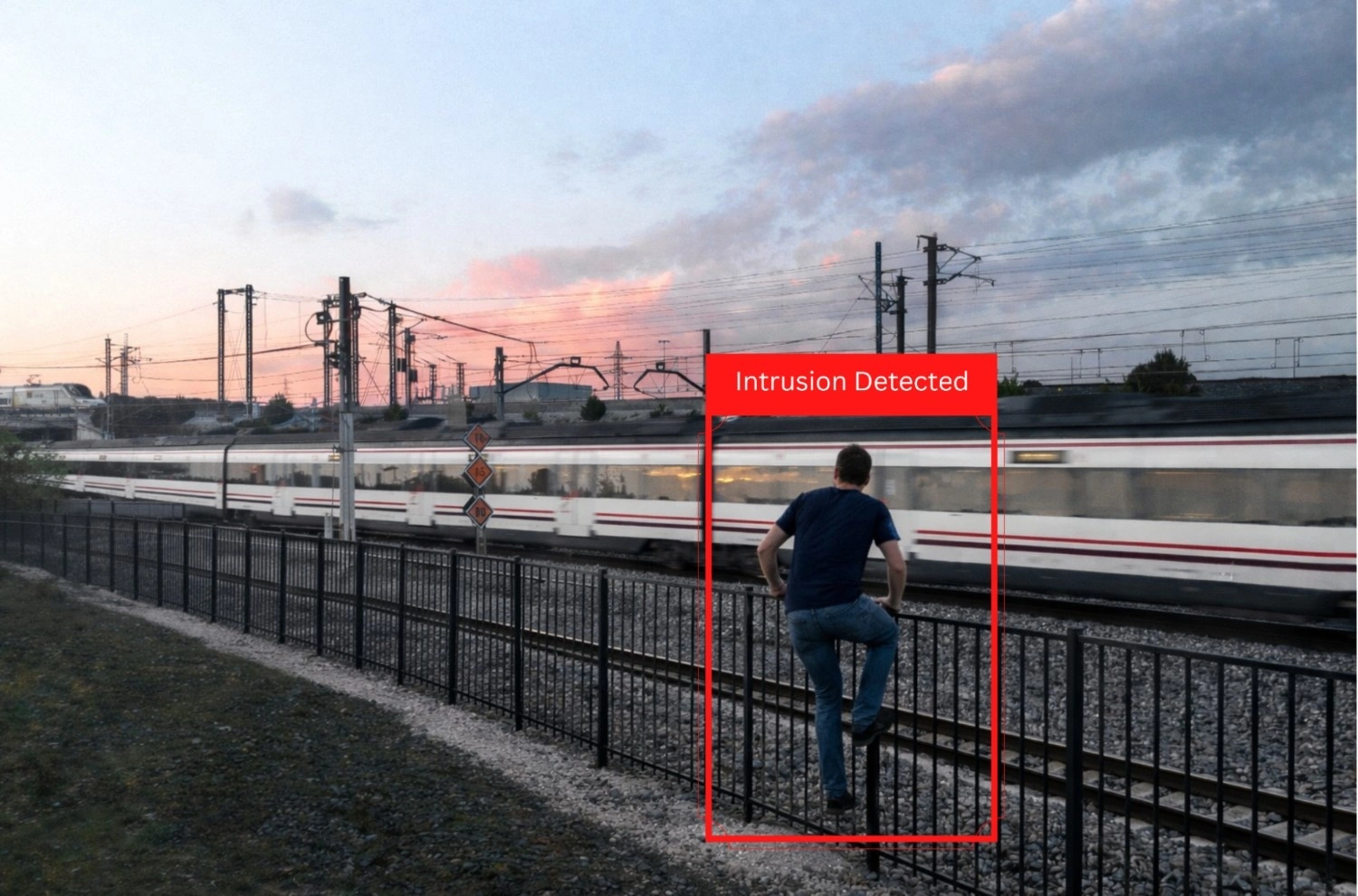
Man trespassing by climbing railway fencing detected by intrusion system

Practical Implementation of ODS and CIDS for Metro Rails

In modern metro corridors transitioning toward fully unattended train operations, ODS and CIDS for metro rails are increasingly deployed as an integrated safety framework rather than standalone systems.

Across upgraded rail alignments, corridor-wide detection solutions combine intrusion detection and obstacle detection to provide continuous monitoring of the entire operational zone. This approach ensures that both physical obstacles and unauthorized intrusions are identified at an early stage, reducing dependence on manual observation.

Fibre-optic sensing technology is often used along rail corridors to detect disturbances, vibrations, or abnormal movements that may indicate an intrusion or obstruction. When an event is detected, it is automatically cross-verified using CCTV feeds, enabling operators to visually assess the situation before initiating operational responses.

This layered detection and verification model demonstrates how ODS and CIDS for metro rails work together to deliver proactive safety, operational confidence, and compliance with stringent rail safety standards. By supporting automated decision-making and real-time situational awareness, such implementations are setting new benchmarks for safety in advanced metro networks worldwide.

Key Benefits of ODS and CIDS for Metro Rails

The value of ODS and CIDS for metro rails extends beyond safety alone.

Enhanced Passenger Safety

Early detection of obstacles and intrusions significantly reduces collision risks.

Reduced Service Disruptions

Faster detection means quicker responses, preventing unnecessary delays and emergency shutdowns.

Operational Efficiency

Automated monitoring reduces dependency on manual patrols and improves control room productivity.

Scalable and Future-Ready

AI-driven metro rail safety systems adapt to new environments, supporting network expansion and automation.

Applications Across the Metro Rail Ecosystem

ODS and CIDS for metro rails are designed to function across the entire metro infrastructure, not just on open tracks. By offering continuous monitoring across operational zones, these systems help metro operators identify risks early, respond faster, and maintain uninterrupted services.

1. Track and Tunnel Monitoring

Tracks and tunnels are among the most critical and high-risk zones in any metro network. Even minor obstructions in these areas can lead to emergency braking, service disruptions, or serious accidents.

With ODS and CIDS for metro rails, continuous monitoring ensures that debris, fallen objects, animals, or unauthorized individuals are detected well before a train enters the section. In tunnels, where visibility is limited and access is restricted, intelligent detection eliminates blind spots and enhances safety in enclosed environments.

2. Platform Safety Monitoring

Platforms are high-footfall areas where passenger behavior can directly impact safety. ODS and CIDS for metro rails help detect unsafe behaviors such as crossing safety lines or accidental falls, enabling early alerts and rapid intervention.

3. Depot and Yard Security

Depots and yards require strict access control to prevent safety hazards and operational delays. ODS and CIDS for metro rails monitor perimeters and internal zones, detecting unauthorized movement and reducing reliance on manual patrols.

4. Level Crossing Protection

In corridors with level crossings or mixed-use interfaces, ODS and CIDS for metro rails detect stalled vehicles, pedestrians, or unexpected obstacles, allowing operators to take preventive action before collisions occur.

Conclusion

As metro networks move toward automation and unattended operations, safety systems must evolve beyond traditional monitoring. ODS and CIDS for metro rails provide the intelligence required to detect risks early, verify events accurately, and support confident operational decision-making.

Katomaran Technologies combines AI-driven video analytics with deep domain expertise in metro rail safety systems to help operators meet today’s challenges while preparing for the future. With scalable and reliable solutions, Katomaran enables transit authorities to build future-ready metro networks without compromising safety.

PreviousFrom CCTV to Cognition: Airport Use Case for Facility Intelligence Infrastructure
SHARE

Table of contents

Related Articles

Top Benefits of Using Video Analytics in Business Operations

Top Benefits of Using Video Analytics in Business Operations

19 Nov, 2024
7 min read
Why Video Analytics is the Necessity of Modern Security Systems

Why Video Analytics is the Necessity of Modern Security Systems

29 Jan, 2025
10 min read
How AI & IoT Are Transforming Air Monitoring in Indian Cities

How AI & IoT Are Transforming Air Monitoring in Indian Cities

10 Mar, 2025
8 min read
Down WaveUp Wave
Logo

#348-1A3, Sri Lakshmi Nagar II, Thanneer Pandhal Road, Peelamedu, Coimbatore, India - 641004

Quick Links

  • Services
  • Case Studies
  • About
  • Blogs
  • Careers
  • Contact Us
  • Sitemap

Services

  • Generative AI
  • Video Analytics
  • Mobile App Development
  • Web Development
  • UI/UX
  • IoT

Products

  • Product Overview
  • VMS
  • Video Analytics
  • VSaaS
  • Face Recognition
  • ITMS

Featured Case Studies

Elevating Condo Living: Seamless, Secure, and Smart
Case study on how Katomaran Technologies developed a Condo App for a gated community in Singapore, enhancing security, convenience, and community living.
View Case Study
Air Quality Monitor - Smart Air Monitoring Solution
A cross-platform environmental monitoring app with live sensor fusion, adaptive UI, encrypted sync, and actionable air-quality alerts.
View Case Study
Car Rental Platform for Oman's Leading Automotive Seller
This case study explores how Katomaran Technologies partnered with a leading automotive seller in Oman to create a groundbreaking car rental platform. Designed to make renting a car effortless for travelers worldwide, the platform offers a wide range of vehicles, long-term leasing options, and a dedicated section for buying trusted used cars. With a focus on simplicity, transparency, and customer satisfaction, this project transformed the rental experience in Oman.
View Case Study
AI-Powered Tire Inspection System
An AI-powered vision system that spots print defects in real time—keeping the tire line moving and every wheel traceable.
View Case Study

Copyright 2018-2026

Developed with lots of ❤️ and ☕ from Katomaran

All rights reserved.