Understanding the Two Approaches
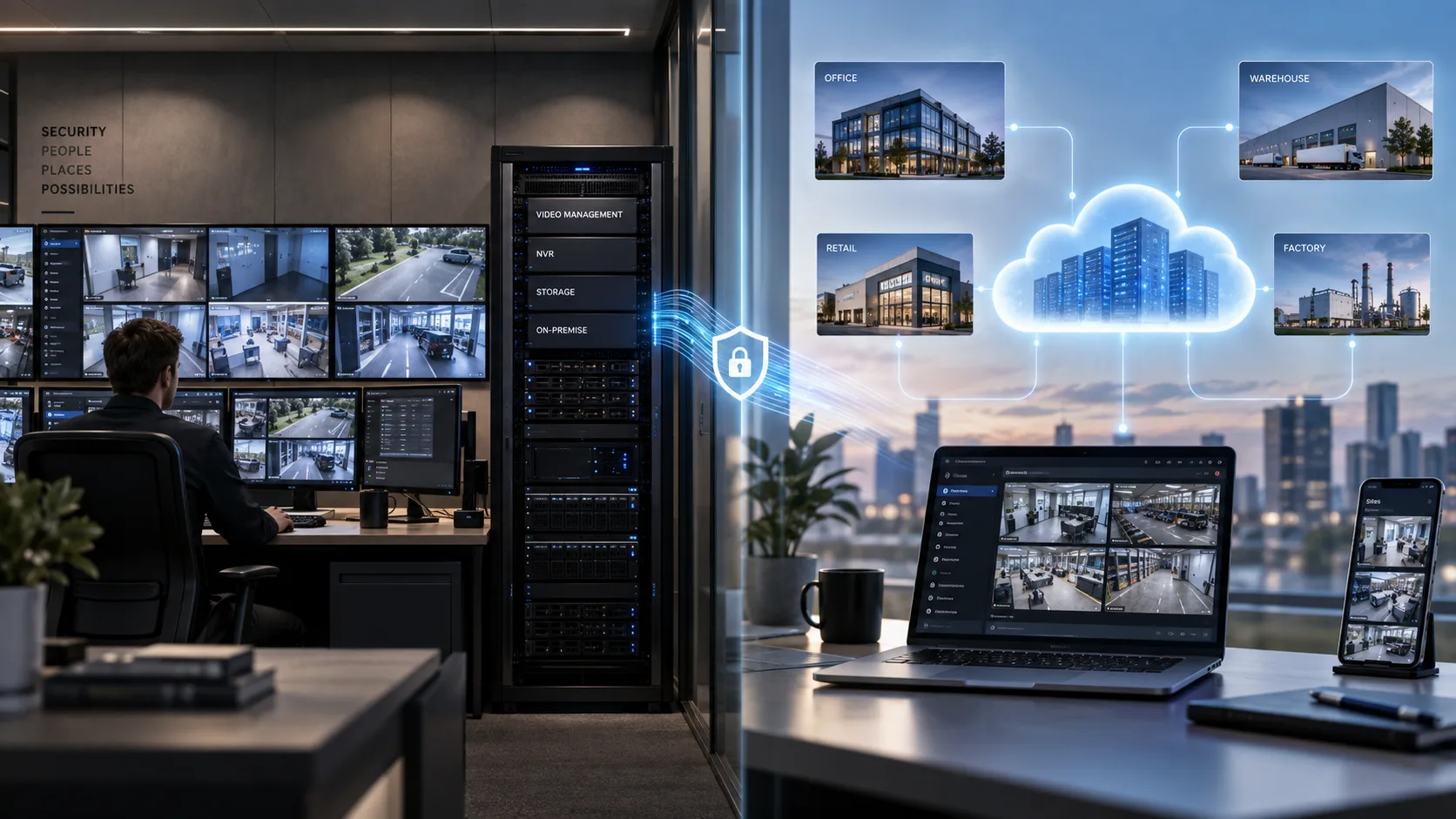
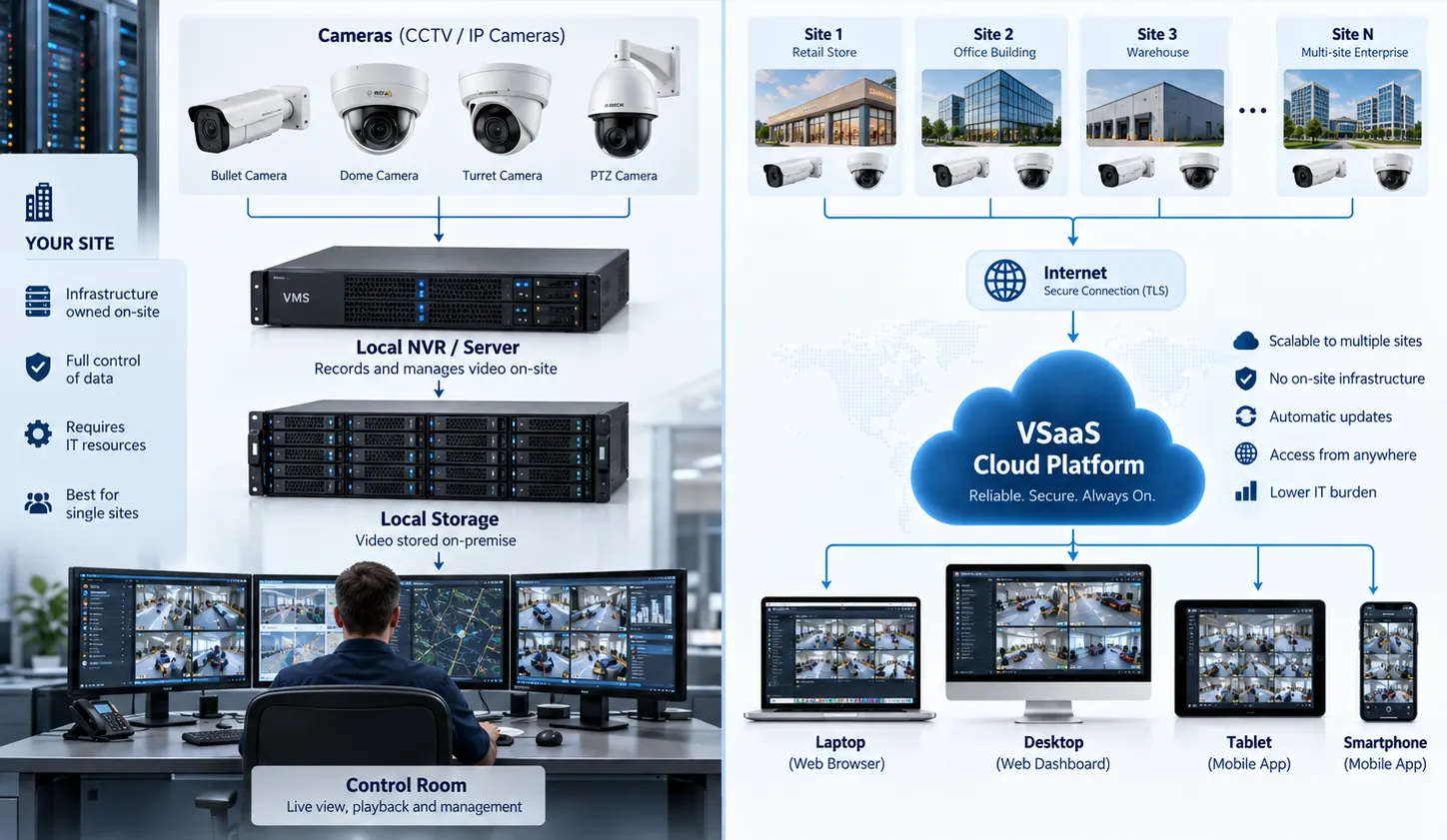
Video Management System (VMS) and Video Surveillance as a Service (VSaaS) tackle the same challenge of managing camera footage through two different methods of operation. A VMS takes place on infrastructure owned and maintained by the organization, usually in an on-site server or NVR hosted at the premises, which is managed by the internal IT team or an integrator. VSaaS is based on cloud infrastructure provided by a cloud services provider, whose subscription service offers recording, storing, and managing the recorded footage rather than having you buy the physical equipment.
Neither technology is better than the other. Each one was created and developed under different conditions regarding connectivity, available budget, and company size, and these conditions still exist. According to MarketsandMarkets, the global VSaaS market size is expected to grow from around USD 5.88 billion by 2026 to USD 12.01 billion by 2032, with a CAGR of 15.4%, and Southeast Asia expected to account for nearly 47% of the market by value by 2026. This is a reflection of the shift in consumer preferences, but does that mean that VSaaS is a solution for every company, or is it better to think logically through the decision-making process?
Our earlier explainer on what VSaaS actually is covers the underlying cloud model in more depth. This piece focuses on the practical decision: given your specific sites, budget, and connectivity, which model or which combination actually fits.
Core Operational Differences: VMS vs VSaaS
| Criteria | On-Premise VMS | VSaaS (Cloud) |
|---|---|---|
| Infrastructure and Ownership | Requires physical infrastructure at every site NVR/recording server, local storage, and network setup for remote access. Organisation owns the hardware and is responsible for upkeep, replacement, and lifecycle. | Minimal local infrastructure; cameras stay on-site, but recording, storage, and the management interface live with the cloud provider. Organisation pays for access rather than owning servers. |
| Cost Structure & TCO | Significant upfront capital cost (hardware, licensing, installation), followed by comparatively lower ongoing maintenance and periodic upgrade costs. Can cost less over a long lifetime with no major hardware refresh. | Minimal upfront cost, recurring subscription that scales with camera count and retention period. More practical for organisations opening/closing sites often or avoiding large capital spend see cloud-based VSaaS for SMEs. |
| Scalability & Multi-Site Expansion | Adding a site means procuring and installing hardware there, then integrating it into the existing centralized view. | Largely a configuration exercise cameras connect to the existing cloud platform without new local recording infrastructure. Compounds in favor of VSaaS for organisations with many small/mid-sized sites see centralizing multiple locations into one control room. |
| Remote Accessibility & Monitoring | Supports remote access, but typically requires deliberate network configuration (VPNs, port setup) at each site to enable it securely. | Built around remote accessibility by default live viewing, alerts, and footage search from any authorized device without extra network configuration. Matters most during live incidents see how VMS improves security team response during critical incidents. |
| Software Updates | Depends on internal IT or a vendor applying updates at each site individually, so update cadence varies across a multi-site estate. | Updated centrally by the provider, so every site runs current software without local intervention. |
| Data Control, Security & Compliance | Footage stays entirely within infrastructure the organisation controls matters for strict data-handling requirements or regulated sectors. | Footage sits on the provider's infrastructure, governed by their security and data-handling policies generally sound with a reputable provider, but a step removed from direct organisational control. |
Hybrid Models: The Practical Middle Path
For many organizations, the straightforward answer to the question regarding their choice between a VMS and a VSaaS solution is straightforward: both VMS and VSaaS are being used together. Hybrid architecture allows recording and primary storage to reside on-premises while adding another layer for remote access and monitoring.
This is more of a hybridized system that uses all of the advantages offered by both methods rather than a compromise. Recording takes place locally at all times, regardless of the internet status. The cloud layer provides remote visibility, addressing the access limitation that makes pure on-premise deployments hard to manage across many sites.
Market research reflects this shift toward blended models. According to Mordor Intelligence, the global VMS market valued at an estimated USD 13.74 billion in 2025 is projected to grow at a CAGR of around 19.1% through 2030, with cloud and VSaaS-linked deployments within that market expanding at a notably faster rate than the market overall. Separately, MarketsandMarkets' VSaaS market segmentation notes that hybrid deployment types are expected to record the highest CAGR of any deployment category over the forecast period. Both figures point in the same direction: organisations increasingly aren't choosing one model exclusively, they're combining them.
Our large-enterprise VMS overview and our piece on VSaaS for multi-branch businesses both touch on how this layered approach plays out for organisations at different scales.
Decision Framework: Matching the Model to the Organisation
A few honest questions tend to clarify which model fits better than any generic comparison table can.
How many sites, and how often does that number change? A single site or a small, stable set of locations often justifies the upfront investment in on-premise VMS. An organisation regularly opening, closing, or reconfiguring sites benefits more from VSaaS's lower switching cost per location.
What does connectivity actually look like at each site, not in aggregate but individually? A VMS deployment tolerates poor connectivity better, since recording doesn't depend on it. A pure VSaaS deployment needs consistent, adequate bandwidth to function reliably.
What's the budget structure available capital for upfront investment, or a preference for predictable recurring cost? This often has more to do with how the organisation's finance function is structured than with the technology itself.
What compliance or data-residency obligations actually apply? If footage must demonstrably remain within organisational infrastructure, that constrains the decision regardless of other factors in VSaaS's favor.
Practical Considerations for Indian Deployments
A few realities specific to Indian operating conditions shape this decision more than generic market comparisons suggest.
Last-mile connectivity still varies significantly by location. A corporate office in a metro city and a manufacturing unit on an industrial corridor rarely have comparable bandwidth, which makes a uniform, organisation-wide choice between pure VMS and pure VSaaS harder to justify than a site-by-site or hybrid approach.
Camera estates across Indian facilities tend to be mixed-vendor, accumulated over years rather than deployed uniformly. Compatibility with existing hardware, rather than requiring a full camera replacement, is often a bigger factor in the decision than the recording model itself.
Power reliability at edge sites is another practical constraint. Local recording infrastructure needs to tolerate power fluctuations gracefully, which is one reason many Indian organisations lean toward hybrid models local resilience paired with cloud-based visibility rather than committing fully to either extreme.
Data-residency and compliance expectations are becoming more prominent considerations as well, particularly for organisations in regulated sectors or those handling sensitive facilities, which again tends to favor architectures where primary footage stays on infrastructure the organisation directly controls.
Closing Thoughts
Neither VMS nor VSaaS has a definitive answer, as there is only the right answer for a particular organisation based on the number of sites, connectivity, budget, and compliance. Most of Indian organisations have a mix of well-connected and poorly-connected sites, and they can use the hybrid method of keeping the local recording intact and getting cloud visibility where needed.
If you are trying to find the right option for your sites, the best way to start is with a self-examination or reach out to a team of experts like Katomaran, who can guide you in selecting the right option.
Frequently Asked Questions
Is VSaaS always cheaper than traditional VMS?
Not necessarily. VSaaS eliminates the burden of upfront costs, but the subscription fees may be more in the long run, provided you have a longer lifetime for the on-site deployment. Therefore, the right alternative depends on the lifetime of the expected deployment and not simply on the upfront costs.
Can an existing on-premise VMS be migrated or hybridised?
Most often, yes. Instead of getting rid of the recording equipment, a layer of cloud accessibility may be placed on top of it. This allows for both remote monitoring and centralized management alongside continuous local recording, in effect transforming a traditional solution into a hybrid one.
How does network reliability affect the choice in India?
Significantly, and not across all sites fairly. Locations with consistently good enough bandwidth can handle the features dependent on cloud technology easily. However, if connectivity is inconsistent, it is much better to keep the recording equipment local with the function of cloud accessibility added only to those sites with the connection good enough to provide it.
Which model is better for organisations with strict data-residency requirements?
On-premise or hybrid architecture generally suits these requirements better than pure cloud, since primary footage remains on infrastructure the organisation directly controls. Pure VSaaS places that footage on the provider's infrastructure, which may not satisfy stricter residency or audit requirements.
Do both models support video analytics equally well?
Largely, yes analytics capability depends more on the platform and cameras in use than on whether recording happens on-premise or in the cloud. What differs is where the analytics processing happens and how quickly flagged events surface to the operator, which varies by specific implementation rather than by deployment model alone.

Eswaravel Ekambaram
Co-Founder & COO
Eswaravel Ekambaram is Co-Founder & COO of Katomaran Technologies, driving operations, system architecture, and enterprise deployment of AI video analytics, VMS, and IoT solutions.