Introduction
A fixed-time signal at a mid-sized Indian intersection runs the same 90-second cycle at 3 AM as it does during evening peak hour. Doesn't matter if the road is empty or backed up three lanes deep; the light changes on schedule, not on demand. That's still how most signalized intersections in Indian cities operate today, and it's the reason adaptive traffic signal control exists as a category.
The Problem with Fixed-Time Traffic Signals
Fixed-time control means exactly what it sounds like: a controller runs pre-programmed cycle lengths and phase splits, usually organized as a handful of time-of-day plans (morning peak, midday, evening peak, night). An engineer studies traffic counts once, updates the plans every few years if at all, and the signal follows that schedule regardless of what's actually happening at the junction on a given day.
This appears to serve the functionality when traffic is predictable. It breaks down the moment conditions deviate from the study: a stalled auto-rickshaw blocking a lane, a wedding procession spilling onto the carriageway, monsoon flooding rerouting traffic onto a road never sized for the load, or a couple of riders having an argument on the road. None of that shows up in a fixed-time plan. The signal keeps running its scheduled cycle while the actual traffic pattern has already moved on. Add construction detours or event traffic and the mismatch gets worse: vehicles queue at a red phase serving an empty cross street, or a green phase runs its full duration for traffic that cleared thirty seconds earlier.
What Adaptive Traffic Signal Control (ATSC) Actually Means
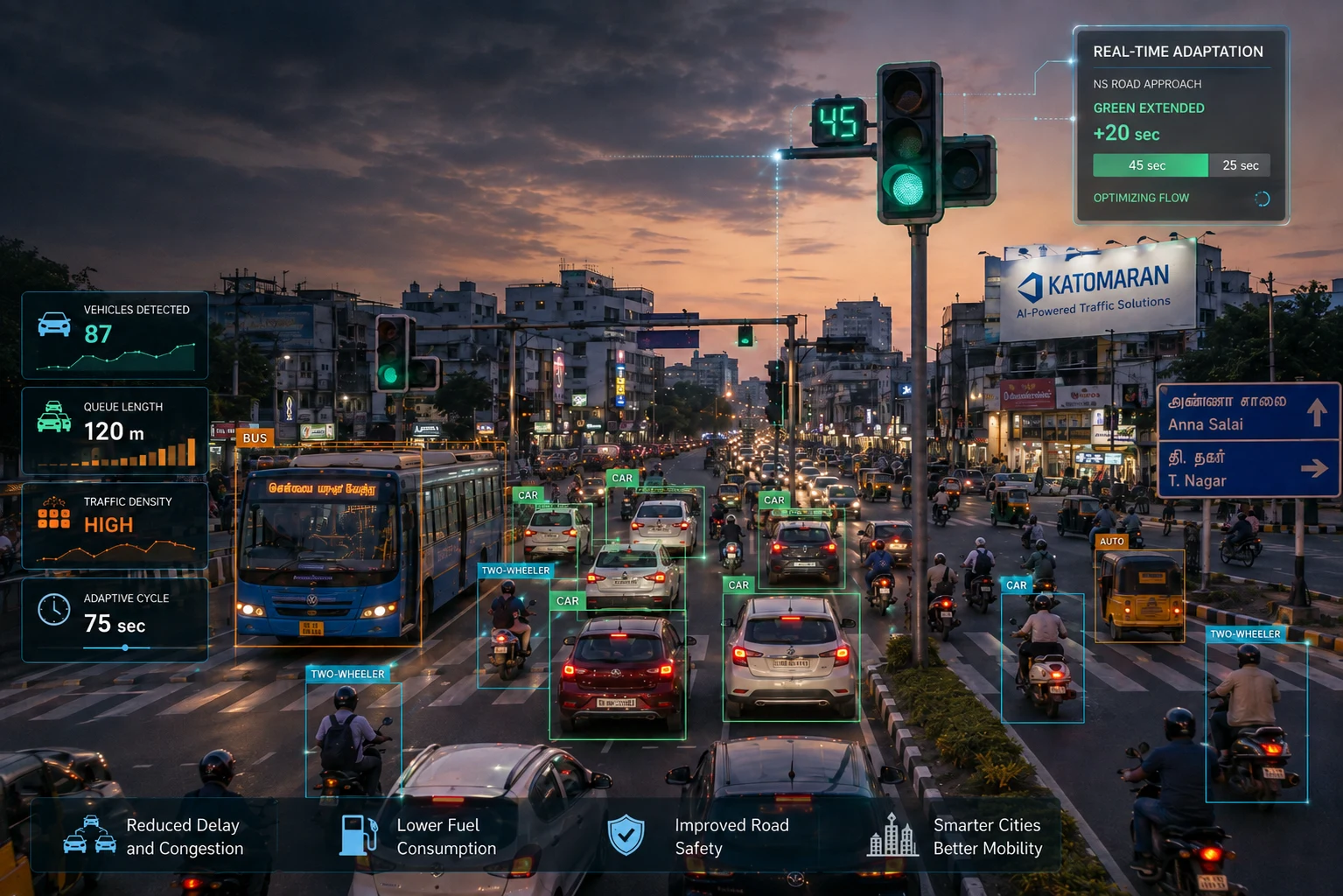
Adaptive traffic signal control, often called an adaptive traffic control system (ATCS), replaces the fixed schedule with a system that reads current traffic conditions and adjusts signal timing in response, cycle by cycle. Instead of a plan written once and left to run, an adaptive traffic signal system continuously pulls in data on approaching vehicle volumes, queue lengths, and gaps in traffic, then recalculates how long each phase should stay green.
Adaptive and actuated control get used interchangeably, but they're not the same thing. An actuated signal extends or shortens a phase based on a vehicle detector at that one approach—useful, but reactive and local. Adaptive signal control technology treats the intersection as a system, and often a corridor of intersections together, adjusting timing across all of them using live data rather than a single trigger.
Fixed-Time vs Actuated vs Adaptive Signals: Key Operational Differences
Some Indian Tier 1 cities run a mix of fixed-time and some actuated control at their busier junctions. Adaptive sits a step above both, built for the kind of variability that fixed-time and single-point actuated control can't respond to—a construction detour, a market-day crowd, or a festival that doesn't follow last year's traffic study.
| Feature | Fixed-Time | Actuated | Adaptive |
|---|---|---|---|
| How timing is set | Pre-programmed time-of-day plans | Extends or truncates a phase based on a local detector call | Recalculated continuously from live, corridor-wide data |
| Data used | Historical traffic study, updated periodically | Presence or passage detection at one approach | Real-time volume, queue length, and gap data across the intersection or corridor |
| Relative cost | Lowest - controller plus timing plans, minimal hardware | Moderate - added detectors at each approach | Highest - detection, communication links, and optimization software layered on the controller |
| Best-fit scenario | Stable, predictable traffic patterns | Isolated junctions with variable but localized demand | Corridors with fluctuating volumes, multiple junctions, or unpredictable events |
How Adaptive Traffic Signal Control Works
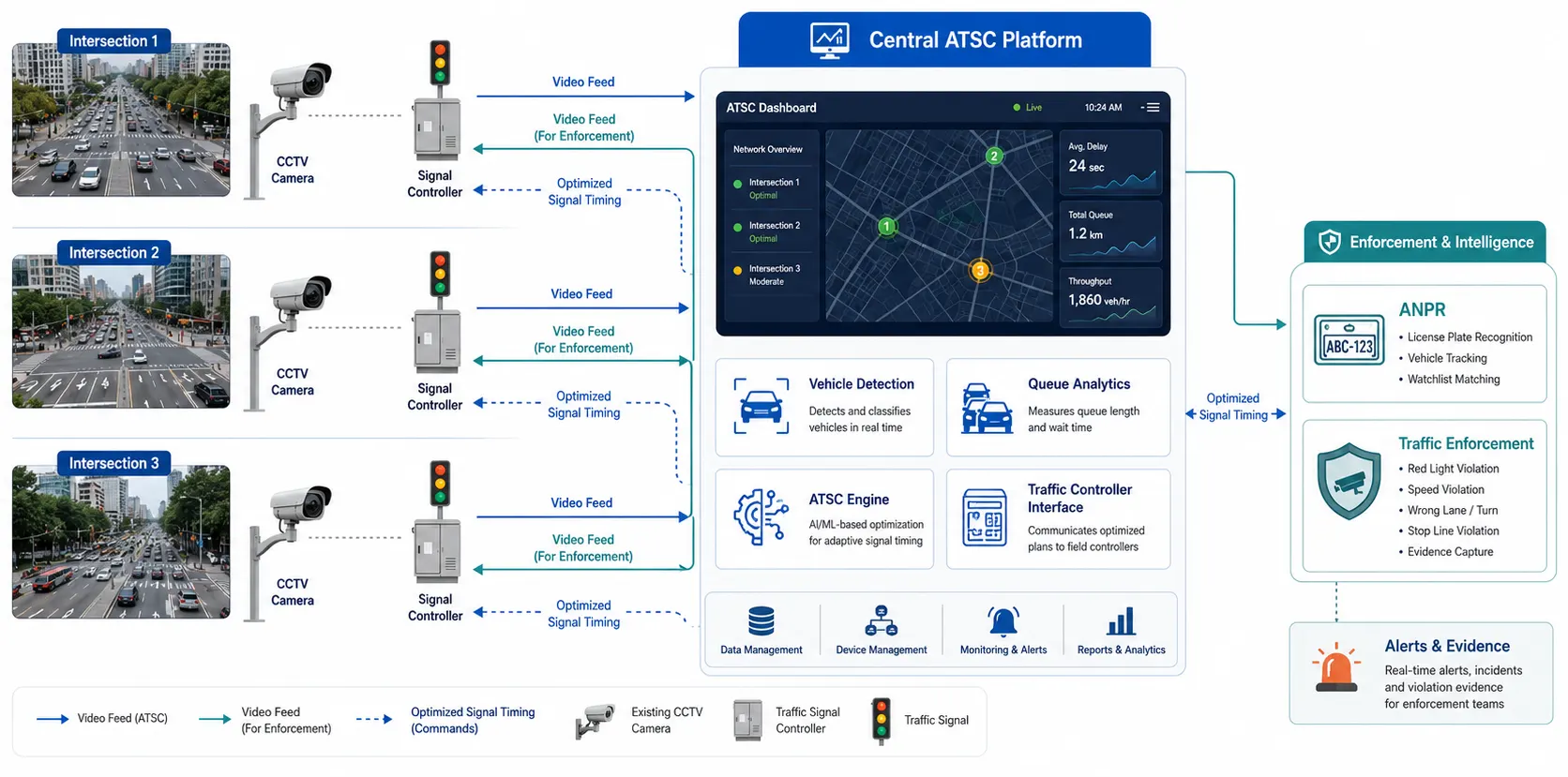
Platforms like SCOOT and SCATS have run adaptive traffic control on signalized corridors internationally for decades, mostly built around inductive loops buried in the road. What's changed more recently is the detection layer: computer-vision systems can now handle much of that sensing using cameras many cities have already deployed. The underlying logic follows the same sequence at every adaptive intersection.
The Step-by-Step Adaptive Traffic Control Process
1. Vehicle detection and data collection
Every adaptive system starts with sensing what's actually on the road. Traditional deployments use inductive loops cut into the pavement, or radar and microwave sensors at the approach. Video-based detection has become the more practical option for many Indian junctions: a single camera can cover multiple lanes and both directions of a wide approach, count vehicles by type, and estimate queue length without new pavement work. That matters for cities building on existing IoT-connected traffic management infrastructure rather than starting from a blank junction, since the sensing layer can often reuse cameras already mounted for surveillance.
2. Real-time traffic analysis
Raw detection data on its own doesn't tell a controller anything useful; it has to be turned into a read on current conditions. Rule-based systems apply threshold logic: if queue length crosses a set point, extend the phase by a fixed increment. More capable systems use models trained on historical and live traffic patterns to predict how a queue will evolve over the next cycle instead of reacting to what's already there. This is the part that separates AI traffic signal management from a simple threshold controller: the analysis engine recognizes patterns across multiple approaches at once, something a fixed rule can't do.
3. Signal timing optimization
Once the analysis engine has a read on conditions, it works with three levers: cycle length (how long a full rotation through all phases takes), phase split (how that cycle time is divided among approaches), and offset (the timing relationship between adjacent signals along a corridor, so vehicles catch a green wave instead of stopping at every junction). Real-time traffic signal optimization means recalculating these three variables every cycle, or every few seconds in more advanced systems, rather than locking them in for an entire time-of-day block.
4. Execution and controller communication
The optimized values only matter if the roadside controller actually applies them. This is where a lot of Indian deployments hit friction; many junctions still run older fixed-time controllers that were never built to accept live timing updates. Retrofitting or replacing these with controllers that support real-time traffic signal timing changes, and confirming the communication link between the analysis engine and the controller stays reliable, is as much a part of the deployment as the detection hardware itself.
5. Continuous feedback and adjustment
The loop doesn't stop after one adjustment. The system keeps collecting fresh detection data, re-analyzing conditions, and pushing updated timing every cycle at some intersections, every few minutes at others, depending on configuration. That continuous correction is the real value of intelligent traffic signal control. A fixed-time plan is right for the average day and wrong for every day that deviates from it. An adaptive system keeps recalibrating against whatever's actually happening.
Practical Challenges in Indian Urban Conditions
Everything above assumes reasonably well-behaved traffic. Indian intersections rarely offer that. Vehicles in Indian roads don’t queue in the tidy single-file rows. Solutions that work outside India are often built for disciplined driving behaviour that fail in scenarios where chaos is observed daily, as in Indian roads. Two wheelers cut across cars, autos cut across lanes and a single approach can carry five vehicle types moving at different speeds. Detection systems built on traffic patterns from elsewhere tend to undercount two-wheelers or misjudge queue length when lane markings aren't followed closely.
Pedestrian behaviour adds another layer—crossing outside designated zones, or at points along the approach rather than the stop line, doesn't map cleanly to the phase logic most adaptive systems assume. Peak-hour congestion here also tends to saturate faster and clear more slowly than the models many adaptive platforms were designed around, since demand routinely exceeds capacity rather than just approaching it.
Then there's the physical layer: power reliability at the roadside cabinet, and network connectivity between the intersection and wherever the analysis runs. A system that depends on a constant link to a central server needs a documented fallback mode for when that link drops—the signal still has to run safely on local logic until connectivity is restored. Any city evaluating smart traffic lights India-wide should ask vendors specifically how their system degrades, not just how it performs when everything's connected.
Where Adaptive Control Delivers the Most Value
Adaptive control isn't equally useful everywhere. It earns its cost on corridors with real variability—junctions near schools, markets, or transit hubs where demand shifts sharply through the day, closely spaced signal groups where coordinating green waves matters, and locations prone to one-off disruptions like construction or event traffic that a fixed plan can't anticipate. On intersections that see steady, predictable volumes, a well-tuned fixed-time or actuated plan can perform close to as well, at a fraction of the cost. The general engineering pattern is fewer unnecessary stops and less manual retiming after the fact, though the size of that gain depends on the corridor. Evaluate case by case rather than assuming a fixed result.
How Katomaran’s Adaptive Signal Control Works
Most adaptive deployments have historically required new detection infrastructure—loops cut into the road, radar units at each approach. Our approach uses the camera network many cities across the world already have, or are deploying anyway for surveillance and enforcement, as the detection layer for adaptive signal control. The same video feed that supports ANPR and speed enforcement can also feed vehicle counts and queue estimates into the timing engine, so a city isn't running two separate sensing systems for two separate purposes. That's the practical case for integrating CCTV infrastructure with ITMS instead of running signal optimization and surveillance as separate procurements. The camera does both jobs and the engineering and enforcement teams work off the same data.
Implementation Considerations Before Deployment
Before committing to an Adaptive traffic signals rollout, a few things matter. Starting with a pilot corridor rather than a city-wide switch. A handful of adjacent junctions with known congestion patterns gives enough data to validate the system without betting the whole network on day one. Confirm controller compatibility early; if the existing hardware can't accept real-time updates, budget for that upgrade alongside the detection and software layers, not as something discovered mid-rollout. Plan for power and network redundancy at each cabinet, with a documented fallback for connectivity loss. Build in a transition period where traffic engineers can review and override the system's timing decisions, until confidence in its behaviour at that specific corridor is established. For corridors that also involve enforcement or wider monitoring, check how the signal system fits into the broader highway and corridor-level ITMS setup instead of planning it in isolation.
Closing Thoughts
Adaptive traffic signal control makes the most sense as a targeted upgrade for corridors where variability actually costs time and safety, not every junction in the city. The technology itself, from detection through timing optimization, is well understood. The harder part is fitting it to Indian road conditions, legacy controllers, and connectivity realities on the ground. Tighter integration with connected-vehicle data and more capable pattern-recognition models will likely extend what these systems can anticipate over time, building on the same detection-analysis-execution loop already running today.
If you're evaluating adaptive signal control for a specific corridor, the useful next step is usually a traffic study of that stretch of road—current volumes, peak patterns, and existing controller capability—before deciding on detection hardware or a software vendor.
Frequently Asked Questions
1. What is the difference between adaptive and actuated traffic signal control?
Actuated control adjusts a single phase at one approach based on a local vehicle detector. Adaptive traffic signal control works across the whole intersection, or a full corridor, recalculating cycle length, phase split and offset from live data at every approach.
2. Can adaptive traffic signal control run on the fixed-time controllers cities already have installed?
Most older fixed-time controllers are built to run a stored schedule and can't accept live timing updates from an external analysis engine. A controller swap or firmware upgrade is usually needed before an adaptive traffic control system can be deployed.
3. How much more does an adaptive traffic control system (ATCS) cost than fixed-time signals?
Adaptive systems cost more due to the detection hardware and analysis software a fixed-time plan doesn't require. The exact difference depends on whether existing CCTV infrastructure can be reused for detection or new sensors need to be installed.
4. Does adaptive traffic signal control account for two-wheelers and non-lane traffic?
Detection accuracy depends on how the system was trained. Models built on lane-disciplined traffic can undercount two-wheelers or misjudge queue length in mixed conditions. Systems intended for Indian deployment should be tested against local, mixed-traffic footage before rollout. This is the place where Katomaran’s solution stands out.
5. What happens to signal timing if the network connection to the analysis engine fails?
A properly designed adaptive traffic signal control system falls back to local logic at the controller, running a default fixed-time or actuated plan until connectivity is restored. This fallback behaviour should be confirmed with any vendor before deployment.
6. Is adaptive traffic signal control the same as an ITMS?
No, adaptive traffic signal control is one function within a broader Intelligent Traffic Management System. An ITMS typically also covers ANPR, speed enforcement, incident detection and centralized monitoring, using much of the same camera and network infrastructure.


Eswaravel Ekambaram
Co-Founder & COO
Eswaravel Ekambaram is Co-Founder & COO of Katomaran Technologies, driving operations, system architecture, and enterprise deployment of AI video analytics, VMS, and IoT solutions.