Introduction
Still seeing vehicles overspeeding even after implementing speed detection solutions?
Are vehicles slowing down only at camera points or speed radars, and then speeding up again in areas without monitoring? If so, spot speed detection may not be enough.
This is where Section Speed Enforcement can make a difference by monitoring vehicle speed across a defined road section rather than at a single point. In this article, we’ll look at how Section Speed Enforcement works, its architecture, key advantages, and the practical limitations of traditional spot-speed enforcement.
What is Section Speed Enforcement?
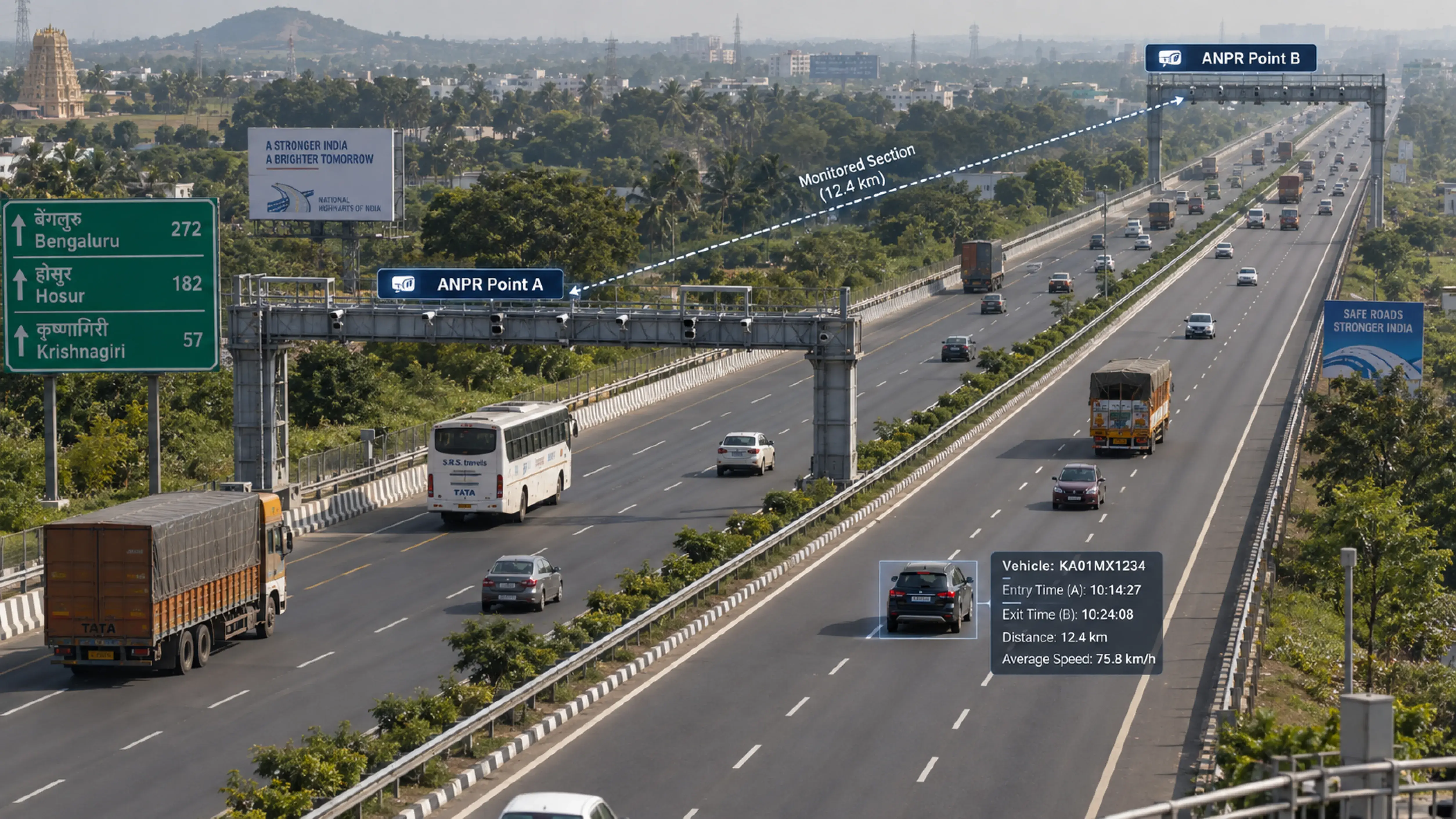
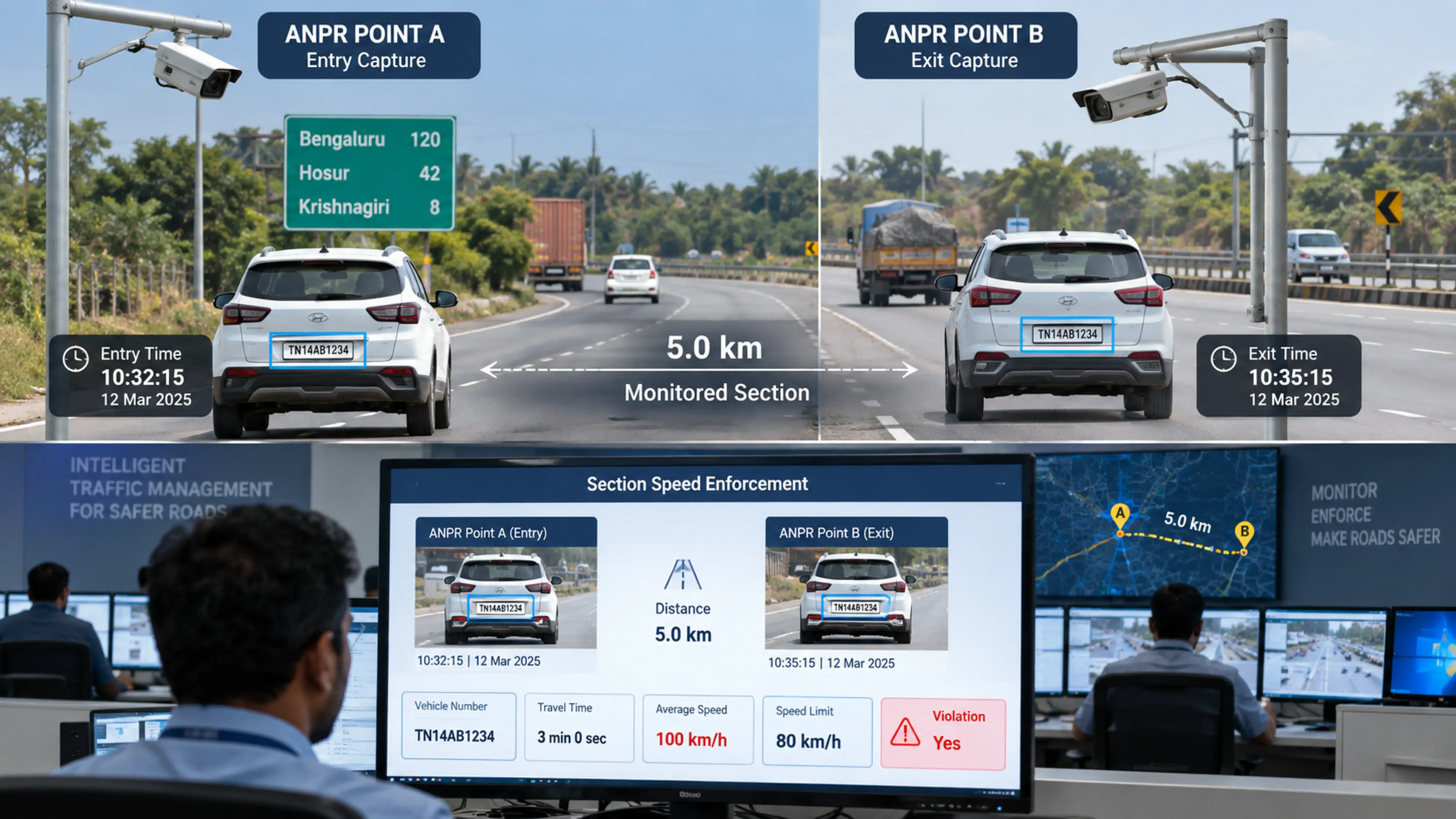
Section speed enforcement measures how fast a vehicle traveled between two fixed points on a road, rather than how fast it was moving at a single instant. A vehicle is identified by its number plate at the start of a defined stretch of road, identified again at the end of that stretch, and its average speed is calculated from the distance between the two points and the time it took to cover that distance.
This is a fundamentally different measurement from a point-speed camera, which captures a vehicle's speed at one specific location using radar, lidar, or a similar instantaneous method. Section speed enforcement doesn't care what a vehicle was doing at any single moment along the stretch. It cares about the average behavior across the entire segment, which is a more representative picture of how a vehicle was actually driven over a length of highway or expressway. As a result of implementing ITMS (Intelligent Traffic Management System) solutions with section speeding, the number of accidents will be reduced.
Limitations of Traditional Point-Speed Enforcement
Point-speed cameras have a well-known behavioral problem: drivers slow down for the camera and accelerate again once past it. Over a long stretch of highway with a few known camera locations, this produces a pattern of braking and acceleration clustered around enforcement points, rather than consistent speed compliance across the road.
This matters more on Indian highways and expressways than it might elsewhere, given the mix of traffic typically sharing the same carriageway trucks, buses, private cars, and often two-wheelers, all with different acceleration profiles and different incentives to slow down or speed up around a known camera location. A single point-speed camera also only tells you about the moment of capture. The spot speeding technique says nothing about whether a vehicle was speeding for the two kilometers before that point or the five kilometers after it.
Our earlier piece on ANPR-based speed enforcement and the ITMS evidence workflow covers how point-based ANPR capture and evidence generation work in more detail. Section speed enforcement builds on the same underlying ANPR capability, but applies it across two or more points rather than one.
Core Architecture of a Section Speed System
A section speed system has four core components that need to work together reliably: capture points, time synchronization across those points, a way to match the same vehicle as it moves from one point to the next, and the calculation logic that turns matched detections into an average speed.
ANPR Capture Points
Each end of a monitored section has an ANPR camera capturing every vehicle's number plate as it passes, along with a timestamp for that capture. A section can have exactly two capture points marking the start and end of a stretch, or more than two if the road authority wants intermediate checkpoints along a longer corridor useful on extended highway sections where multiple sub-segments need independent monitoring rather than one long average.
Camera placement matters here more than it might initially appear. Capture points need a clear, consistent view of number plates across all lanes, which becomes harder on Indian highways where lane discipline is inconsistent and vehicles frequently shift lanes, overtake, or straddle lane markings. Our coverage of ITMS deployment across highway corridors goes into camera placement and coverage considerations for these conditions.
Precise Time Synchronization
Average speed is distance divided by time, which means the accuracy of the time measurement directly determines the accuracy of the speed calculation. Every capture point in a section speed system needs its clock synchronized to the same reference time, typically through NTP (Network Time Protocol) synchronization back to a common time source.
A clock drift of even a second or two between two capture points, over a section that a vehicle covers in under a minute, can introduce a meaningful error into the calculated speed. This is why time synchronization isn't a one-time setup step it needs to be monitored continuously, since network devices can drift over weeks or months if left unchecked.
Vehicle Matching Across Multiple Points
Once a vehicle's plate is captured at the entry point and again at the exit point, the system needs to confirm these are the same vehicle before calculating a speed. This matching is done primarily by plate number, since that's the one identifier guaranteed to be consistent across both captures.
In practice, this step needs to tolerate imperfect plate reads. OCR accuracy on Indian number plates varies with lighting, plate condition, mounting angle, and non-standard plate formats that are still common on the road. A good matching system builds in tolerance for near-matches and partial reads, using fuzzy matching logic to handle a character misread at one point without losing the ability to match that vehicle to its other capture.
Average Speed Calculation Logic
With a confirmed match and two timestamps, the calculation itself is straightforward: the known physical distance between the two capture points, divided by the time elapsed between the two timestamps, gives an average speed for that vehicle over that section. If the calculated speed exceeds the posted limit for that section, the system flags the vehicle for a violation, along with both timestamped images as supporting evidence.
The distance value used here needs to be measured precisely and verified against the actual road, not just estimated from a map, since even a small error in this figure carries directly into every speed calculation the system produces afterward.
Key Technical Considerations for Reliable Operation
A few technical details determine whether a section speed system produces defensible results or generates disputes.
Plate read accuracy needs to be high and consistent across both capture points, not just one. A system that reads plates well at the entry point but poorly at the exit point, due to different lighting conditions or camera angle, will systematically fail to match vehicles correctly, understating the true violation count.
Lane coverage matters just as much. On multi-lane highways, capture points need to cover every lane a vehicle might use, including lanes vehicles move into temporarily while overtaking. A gap in lane coverage at either end of the section creates blind spots where a vehicle can pass through unmatched.
Distance accuracy, as noted above, is foundational it should be verified through actual road measurement or a calibrated method, not assumed from straight-line map distance, since roads curve and vehicles don't travel in perfectly straight lines between two GPS coordinates.
Network reliability between capture points is a real constraint in Indian highway and expressway environments, where sections can span areas with inconsistent connectivity. Matching logic and evidence packaging often need to tolerate some delay in data reaching a central processing point without losing timestamp accuracy at the point of capture itself.
Practical Challenges in Real-World Deployments
Mixed traffic conditions create matching challenges that are less pronounced in more uniform traffic environments. A two-wheeler without a clearly mounted or well-lit plate, a heavy vehicle with a mud-obscured plate, or a vehicle with a non-standard or damaged plate all reduce match rates between capture points, which in turn affects how comprehensively the system enforces the speed limit across all vehicle types on the road.
Non-lane driving behavior, common across Indian highways, means capture points sometimes need wider camera coverage angles than would be necessary on a strictly lane-disciplined road, to make sure vehicles weaving between lanes are still captured cleanly at both ends of the section. Our piece on ITMS deployment on freeway and bridge corridors touches on similar coverage considerations for high-speed, high-traffic environments.
Weather and visibility conditions fog on certain highway stretches, heavy rain, or low-light conditions at dawn and dusk affect plate read quality at both capture points, and a system needs consistent performance across these conditions rather than only in ideal daylight.
Evidence integrity also needs attention. Since a violation depends on matching two separate captures rather than a single instant, the system needs to preserve both images, both timestamps, and the calculated speed together as a coherent evidence package, in a format that holds up to scrutiny if the violation is contested. Our overview on integrating CCTV and ITMS for unified enforcement response covers how this kind of evidence handling fits into a broader enforcement workflow.
When Section Speed Enforcement Makes Sense
Section speed enforcement is best suited to longer stretches of highway or expressway where average speed over distance is a more meaningful measure than speed at any single point corridors where consistent speed compliance across several kilometers matters more than catching a momentary spike near one camera. It's particularly relevant on stretches with a history of speed-related incidents distributed across the length of the road rather than clustered at one identifiable spot.
It's less necessary on short urban stretches or at individual junctions, where point-speed enforcement or junction-level violation detection already addresses the relevant risk without needing the added infrastructure of synchronized multi-point capture. Deciding between the two often comes down to the length and nature of the road segment in question, and what kind of driving behavior actually needs to be addressed there.
Closing Thoughts
Section speed enforcement works because it measures what actually matters on a long stretch of road: sustained speed, not a momentary reading. Getting it right depends less on any single component and more on how precisely the capture points, time synchronization, and vehicle matching work together as one system.
If you're evaluating section speed enforcement for a specific highway or expressway stretch, it's worth starting with an honest assessment of that road's traffic mix, lane discipline, and connectivity conditions before finalizing camera placement and segment length.
Our team of experts is glad to walk through what that assessment would look like for your specific corridor.
Frequently Asked Questions
1. What is section speed enforcement?
Section speed enforcement measures a vehicle's average speed over a defined road stretch, not at one instant. A vehicle's plate is captured at the start and end points, and speed is calculated from distance and elapsed time.
2. How is this different from a regular speed camera?
A point-speed camera measures speed at one instant using radar or lidar. Section speed enforcement measures average speed across a stretch instead, so braking near a known camera location doesn't avoid detection.
3. Why does time synchronization matter so much here?
Average speed equals distance divided by time, so any timing error directly skews the result. A drift of even a second or two between capture points can meaningfully distort speed calculated over less than a minute.
4. How does the system match the same vehicle at both points?
Matching relies primarily on the number plate read via ANPR at both ends. Since plate reads aren't always perfect, matching logic needs tolerance for minor misreads without losing the correct entry-exit pairing.
5. Does this work well given non-lane driving on Indian highways?
It can, provided camera coverage accounts for lane-weaving and overtaking. Capture points need wide enough field of view to reliably read plates regardless of which lane a vehicle occupies at either end.
6. What happens if a plate is misread at one point?
If the plate can't be matched confidently between both points, no valid average speed can be calculated for that vehicle, and no violation gets recorded for that particular pass through the section.
7. When does section speed suit a road better than point cameras?
It fits longer highway or expressway stretches where sustained compliance across kilometers matters more than one spike. Short urban stretches or single junctions are usually served well enough by point-speed enforcement alone.

Eswaravel Ekambaram
Co-Founder & COO
Eswaravel Ekambaram is Co-Founder & COO of Katomaran Technologies, driving operations, system architecture, and enterprise deployment of AI video analytics, VMS, and IoT solutions.